
Every HVAC owner in Maryland knows the week. Somewhere in the second half of September the last of the August heat lets go, the overnight lows drop into the fifties, and the phone that rang forty times a day rings nine. The trucks are still in the lot. The techs are still on payroll. The insurance bill still comes. Nothing about the business got smaller except the part that pays for it.
Then it happens again in April.
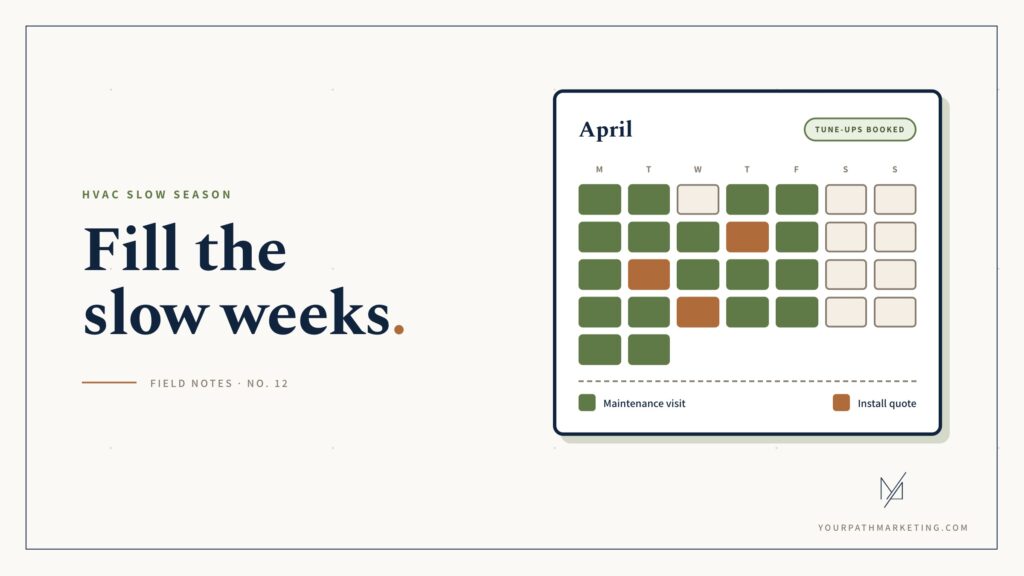
Here is the short version of this whole article. The shops that do fine in September and April decided in June and January what those months were going to be for. The ones that suffer are the ones who treat a slow month like weather. It is not weather. It is a schedule with nothing on it, and a schedule is something you fill.
What a slow month actually costs
Think of a slow month as a system running on standby. Everything is powered. Nothing is producing. The blower motor of the business, which is payroll, keeps turning at full amperage whether or not anyone is calling.
The swing is bigger than most owners admit out loud. Industry benchmarking cited by several 2026 roundups puts roughly three quarters of a typical residential contractor’s annual revenue inside the six peak months, with the other six months sharing the remaining quarter. Treat that as a national average with plenty of variation, but the direction is not in dispute. ServiceTitan’s analysis of heat waves found the first heat event of a summer lifts daily revenue by about 90 percent over a normal summer day, and by the fifth heat wave the lift is down to about 20 percent. Homeowner search behavior follows the same curve. A WebFX analysis of seasonal search, cited in the same roundup, found “AC repair” queries jump more than 260 percent in July and “furnace repair” runs well over 100 percent above baseline in January.
In the Baltimore and DC metro the pattern is specific enough to plan around. Cooling demand spikes at the first stretch of 90-degree days, usually late May or June, and peaks in July. Heating demand spikes at the first real cold snap in late October and peaks from December into January. That leaves two valleys: roughly mid-September through mid-October, and roughly late March through April. Those valleys are the shoulder season, and they are the subject of this piece.
Fill the schedule from the base you already have
Start with the customers who already know your name. Everything else on this list is harder and slower.
A maintenance agreement is the load calculation for your year. It tells you how much of the schedule is spoken for before the weather shows up. A small HVAC company we spoke with on the Eastern Shore put it plainly: the maintenance book is what keeps revenue steady in spring and fall, and it is the reason the shop does not chase marketplace calls or run discounts when the phone slows. Every unit they have sold is a scheduled visit twice a year, and those visits land in exactly the months everyone else is scrambling.
Most homeowners will not do this on their own. Data cited by ServiceTitan puts the share of homeowners who schedule preventive maintenance annually at around 30 percent, meaning about seven in ten wait for something to break. That is not a market problem. That is a reminder problem, and reminders are cheap.
ACCA’s own shoulder-season playbook lists the outbound campaigns that work, and none of them require a marketing budget: call every agreement customer and book the fall tune-up before the first freeze; pull every system in your database over 12 years old and offer an inspection or a replacement conversation; call membership renewals early rather than waiting for them to lapse; go back through unsold estimates from the summer. The point ACCA makes is the one most owners resist. Outbound calling is not what you do when you are desperate. It is what you do in June so that September is already booked.
Two things worth adding. First, a maintenance base does more than fill September. It is also one of the strongest things moving what a buyer will eventually pay for the shop. How much the business earns sets the broad range you get priced in, and the agreement book is a large part of what decides where inside that range you land. Our article on what an HVAC business is worth covers the math and who published the numbers. Second, maintenance customers are the ones who write the detailed reviews. A homeowner who has seen your tech twice a year for six years describes what happened and how it was handled, and that kind of review is exactly what search engines and AI assistants read when a stranger asks who to call.
Let the manufacturers send you work
The same Eastern Shore company said something else that most owners overlook. A meaningful share of their calls come from the manufacturers themselves. The brands they carry refer homeowners to their listed dealers, and those referrals do not stop in October.
Every major brand runs some version of this. Trane Comfort Specialist, Carrier Factory Authorized, Lennox Premier, Mitsubishi Diamond, Bryant Factory Authorized, Daikin Comfort Pro. The requirements differ, the fees differ, and the volume differs by brand and by area. What they share is a dealer locator page that homeowners actually use, especially homeowners who already know what equipment they want. A brand-referred customer arrives with the decision half made.
The catch is that the locator only sends what it can find. If your dealer profile is half filled in, if the phone number there does not match the one on your Google Business Profile, if the service area is blank, the calls go to the shop three towns over whose profile is complete. It is a twenty-minute job that most dealers never do.
What each program actually requires, what it costs you in purchase commitments and brand exclusivity, and how to get the listing sending calls is covered in our article on manufacturer dealer programs.
Adjacent work that fits a residential crew
Some work is easier to sell in mild weather than in a heat wave, and some work you would rather not do in a heat wave anyway.
Ductwork replacement is the clearest case. An ACHR News guest column on surviving slow times makes the point that duct work is labor heavy and nobody wants to schedule it in July, which makes September and April the natural home for it. The same column describes a strictly residential shop that takes on one or two light commercial jobs each off season specifically to keep crews busy, and notes that many of your residential customers own or manage a business.
Indoor air quality work belongs here too: duct cleaning, filtration upgrades, humidifiers, dehumidifiers, and UV. So do thermostat and zoning upgrades, water heaters where your license covers them, and generator maintenance where an electrical license is on staff. None of these are new lines of business. They are things a residential HVAC crew is already qualified to do that customers are more willing to think about when nothing is broken.
Adding a second trade
Plumbing, electrical, and light commercial
You have probably noticed how many trucks in the metro say “heating, air, and plumbing” or “HVAC and electrical” now. Some of that is the corporate roll-ups bundling everything under one local name. Some of it is independents who added a trade to flatten the year. It can work. It is also the item on this list with the most ways to go wrong.
Contractors who have done it say the same things on the trade forums. Liability insurance roughly doubles when you add a second licensed trade. If the whole line depends on one hired plumber or one hired electrician, that hire is a single point of failure, and if he leaves mid-job you are holding work you cannot legally finish. On the positive side, older customers in particular like having one number to call, and the shops that pair the trades report that the second trade tends to bring the first one work as often as the reverse. Several long-running threads on the Mike Holt contractor forum walk through both sides of it.
In Maryland the licensing is not casual. HVACR, plumbing, and electrical are regulated by three separate state boards under the Department of Labor, each with its own experience requirements and exams, and the HVACR Board makes clear that an HVACR license does not extend to line-voltage electrical or to plumbing beyond what is incidental to the system. Local jurisdictions layer permits on top. If you are considering it, start with the board pages, not with the truck wrap.
This is a map of which board to call, not legal advice, and we are not attorneys or license consultants. Requirements change, county permit rules differ, and the answer for your shop depends on who is already on your payroll. Confirm it with the board itself before you spend money on a hire, a wrap, or a website page.
Then there is the part that has nothing to do with licensing and everything to do with whether the new trade produces a single call. Adding a service is like adding a zone. It only works if the ductwork exists. If the trucks say plumbing but the website has no plumbing page, the Google Business Profile still lists you as an HVAC contractor, and no review anywhere mentions a drain, then to every search engine and every AI assistant you are still an HVAC company that occasionally shows up for a leak. Homeowners will not find the new work, and the machines that recommend businesses will not either. If you add a trade, add it everywhere at once: a real service page, the profile categories, the manufacturer and directory listings, and a plan to get the first ten reviews that say the word.
Move installs into the slow months on purpose
A homeowner in April is not desperate. That is bad for emergency work and good for replacements, because a homeowner who is not desperate can wait for financing, ask about rebates, and pick a week. Two levers turn that into booked installs.
The first is financing offered before the failure, not after. The 12-year-old-system callback from ACCA’s list is where this starts: “your system is at the age where a planned replacement in April costs less than an emergency one in July, and here is what the payment looks like.”
The second is the rebate calendar. Maryland’s EmPOWER programs through BGE, Pepco, and the other utilities, plus federal incentives, move heat pump and high-efficiency installs when someone explains them plainly. Program details change often, so the shop that keeps a current, dated rebate page on its site is the shop that gets asked about them, including by the AI assistants homeowners now use to ask “is there a rebate for a heat pump in Howard County.”
What to do with the hours you cannot fill
Some hours will stay empty no matter how well you plan. A ServiceTitan and ACCA survey found that about 65 percent of shops handle the busy season by having the existing team work longer hours rather than adding staff, which means the same people who were slammed in July are the ones standing around in September. The question is not how to eliminate the empty hours. It is what to spend them on so they pay you back in the next peak. Five things earn that time.
- Training and certifications. NATE, EPA renewals, manufacturer courses, and cross-training a junior tech on the equipment you actually sell. This is the work that cannot happen in July and always gets promised for later.
- The trucks and the shop. Deferred maintenance on the fleet, inventory counts, and the truck stock that has been wrong since May. A truck that breaks down in a heat wave costs more than a slow week ever will.
- The reviews you never asked for. Go back through the summer’s completed jobs and ask. Customers who had a good experience in July will still write it down in September, and the detailed reviews are the ones that keep working for you online.
- The list you have never emailed. Every past customer sitting in your software is a booked job you already paid to acquire once. Our article on email marketing for HVAC companies covers the three campaigns worth running and gives you the templates to send them.
- The website. The one that matters most and gets done least. Service pages, dealer and directory profiles, a rebate page, the questions your call log actually asked. Our owner’s guide to search visibility and the local search page cover the mechanics without jargon.
That last one deserves a plain sentence, because it is the one owners understand least. The pages that bring in calls in July were published in February. Search engines take months to trust a new page, and AI assistants recommend businesses whose information they can already find and whose information is kept fresh. The slow season is when that work gets done. It is not when it starts paying. If you wait until the phone is quiet to notice that your website is thin, you have already missed the season it was supposed to carry.
Not to mention the calls that come in during shoulder season. Those go to the HVAC company with the best digital visibility. Whether that’s the top of Google, a ChatGPT recommendation, or your Google Business Profile, this season can be full of booked work with proper planning and the right partner from a year ago.
What not to do
Every one of the ideas above has a shortcut version that looks the same from a distance and costs more every year you use it. Owners reach for the shortcuts because they are fast and the slow month is scary. Three of them do the most damage.
- Deep discounts to fill the board. You are not creating demand, you are training your own customers to wait for September. A modest, time-limited tune-up offer to your existing base is fine. A 40 percent off banner is a habit you will pay for every year after.
- Buying marketplace calls to paper over a slow month. The economics of paying per call are covered in our piece on Angi Leads, and they get worse, not better, when the calls are scarce and the shop is anxious. For how the channels compare over a full year, see where an HVAC dollar works hardest.
- Quietly bolting on a service nobody can find. That was the zone metaphor. Half the “HVAC and plumbing” trucks in the metro belong to companies that get almost no plumbing calls online, because online they are still HVAC companies.
What the three have in common is that they trade next year for this month. The discount, the marketplace, and the half-added trade all produce something in the next two weeks and take it back with interest later. The moves earlier in this article run the other direction: slower to start, and they keep paying after you stop pushing.
If this is your first or second September
Newer owners tend to collect ideas. Experienced owners keep a calendar. The difference is that the calendar has a name next to every month: who is calling agreement customers in August, who is going through unsold estimates the first week of September, when the fall tune-up email goes out, which week in April is blocked for the ductwork jobs, when the rebate page gets updated. A slow season plan is not a list of things you could do. It is a list of things that will happen on a date, owned by a person. Build that in June, and September becomes a month like any other.
Frequently asked questions
When is HVAC slow season in Maryland?
Roughly mid-September through mid-October and late March through April. Cooling demand peaks in July after the first 90-degree stretch, heating peaks December into January after the first cold snap. The two valleys between are the shoulder seasons.
Are maintenance agreements worth it for a small shop?
Yes, and they matter more for a small shop than a large one. Agreements fill spring and fall with scheduled visits, produce the detailed reviews that drive referrals, and are among the biggest factors in what a buyer will eventually pay for the business.
Should I add plumbing to my HVAC business?
Only with a licensed master on staff, a plan for insurance that may roughly double, and a commitment to make the new trade visible everywhere online at once. Done halfway, it costs money and produces few calls.
How do I keep techs busy in the fall?
Book agreement tune-ups in August, call unsold summer estimates and 12-year-old systems in early September, schedule ductwork and light commercial jobs into the valley, and use remaining hours for training and certifications.
What should an HVAC company do in the off season for marketing?
Publish the pages you want to rank in peak season, complete manufacturer dealer and directory profiles, email your past customer list, ask for reviews, and update rebate and pricing pages. Visibility work done in the slow season pays in the busy one.
Use this September to build the next one
Everything on this page comes back to one idea. A slow month is not something that happens to you. It is a schedule you fill, and the shops that fill it decided how months ago. Pick two things from this list to put on the calendar with a name next to them, and the next valley gets shallower.
And if you would rather know exactly where you stand before you decide what to fix, that is what the free visibility audit is for: your rankings in every town you serve, your profile against the competitor winning your market, whether your dealer and directory listings are complete, and whether AI tools name you or them when a homeowner asks who to call. One page, two business days, yours either way. We work with one HVAC company per service area, so it also tells you whether your towns are still open. Here is how the rest works. Worth a look?