
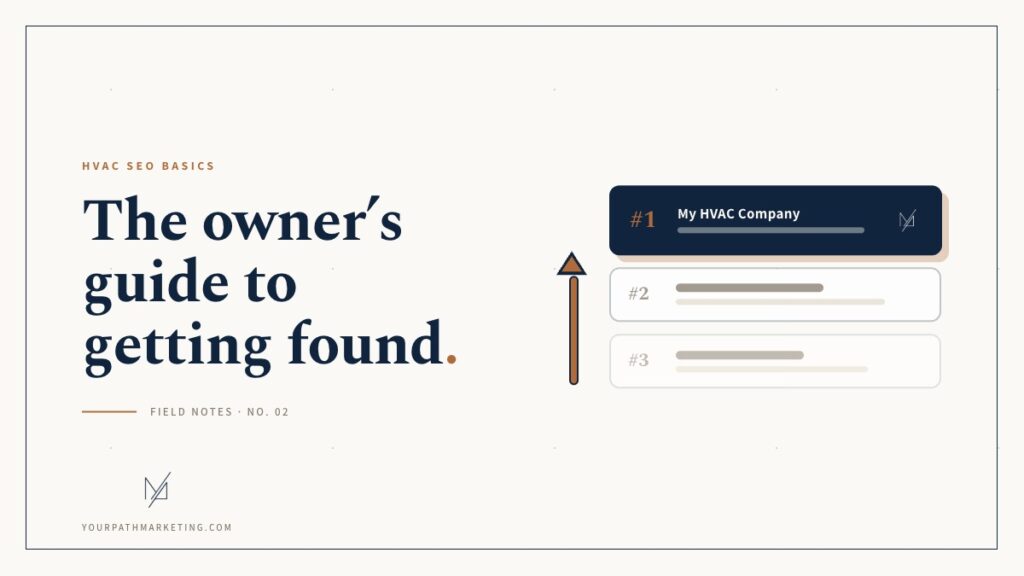
The last customer who found you didn’t drive past your shop. They typed something into a phone at a kitchen table, and a machine decided which three companies to show them.
SEO basics for HVAC companies really come down to one question: how do you become one of the three? This article answers it in plain language. No jargon without a translation, no theory without something you can do this week, and no guesswork about what matters, because the order below is the order that moves the phone.
Fair warning: this is long. The seo basics for hvac companies fit on one page, but only barely, and this is meant to be the one page you need. Skim the headers, dive where it hurts.
What is SEO for HVAC companies? SEO (search engine optimization) is the work of making your company show up when homeowners in your area search for heating and cooling help. It covers three surfaces: Google’s map results, the regular results below them, and now AI answers. Most of the work happens on your Google Business Profile, your reviews, and your website.
How long does HVAC SEO take? Profile fixes can move things in weeks. Competitive map rankings take months and compound from there. Anyone promising you a date or a position is guessing, and you should ask them how they plan to control Google.
Why search decides who gets the call
A homeowner with a dead furnace doesn’t comparison shop. They search, they scan the first screen, and they call. The whole competition happens in about ninety seconds, on a phone, before you know it occurred.
And the first screen is shrinking. A 2026 study by SparkToro and Similarweb found 68% of Google searches now end without a click to any website. Google increasingly answers questions right on the results page: the map pack, the review stars, the AI summary at the top. Your website still matters, but it is no longer the storefront. It’s the warehouse behind the storefronts.
This is also why the game has gotten harder for independents specifically. Corporate-owned competitors wearing local branding invest heavily in exactly these surfaces, with budgets built for it. In our home market, we’ve watched it happen block by block; here’s the Baltimore and DC version of that story. The good news: the assets that win local search (proximity, reviews, real local history) are ones an independent actually holds. You just have to put them where the machines can read them.
The homeowner behavior backs this up. BrightLocal’s long-running consumer review survey consistently finds that the overwhelming majority of consumers use Google to evaluate local businesses and read reviews before choosing one. Your next customer is doing both, tonight, whether or not you’ve done anything about it. That’s the case for learning the seo basics for hvac companies: the evaluation is happening either way. The only question is whether you’re competing in it.
The three places you can show up
Owners often think SEO means “my website’s ranking.” It’s three separate contests, and they reward different things.
The map pack. The three businesses with pins that appear for searches like “furnace repair near me.” This is where most HVAC calls come from, and winning it is the heart of local seo for hvac work. It’s decided by proximity, your Google Business Profile, and your reviews. If you improve one thing this year, improve this. The deeper playbook lives here: local SEO for HVAC companies.
The organic results. The regular listings below the map. This is where research-stage homeowners live: “heat pump vs furnace,” “why is my AC freezing up.” It’s decided by your website’s pages and how well they answer the question asked.
AI answers. The newest surface. Google’s AI Overviews sit above everything, and homeowners increasingly ask ChatGPT and similar tools who to call. Getting named there is called AEO (answer engine optimization), and it runs on the same raw materials: accurate business data, strong reviews, and content that answers real questions. Pew Research Center tracked 900 adults’ real browsing and found people clicked a traditional result on just 8% of searches when an AI summary appeared, versus 15% without one. The answer box is eating the clicks, which means being IN the answer is the new ranking. More on how that works: AI search and AEO for HVAC companies.
Three storefronts, one supply chain. Everything below feeds all three.
How to do SEO for HVAC companies, step by step
Ask ten marketers how to do seo for hvac companies and you’ll get ten proposals and nine invoices. Strip the packaging and it’s five steps, in priority order. Each ends with something you can do this week, yourself, free.
Step 1: claim and complete your Google Business Profile
If SEO is a toolbox, the google business profile for hvac companies is the 80% tool. For many companies it IS the homepage: homeowners read it, call from it, and never visit the website at all.
Complete means complete. Primary category set to HVAC contractor, every service listed individually (furnace repair, AC installation, heat pump service, duct work), accurate hours including whether you truly answer emergencies, and real photos: your trucks, your techs, your installs. Not stock photos. Google’s own profile guidelines reward completeness, and homeowners reward proof that actual humans will show up.
Then keep it alive. Post occasionally, answer the Q&A section (homeowners ask questions there and most companies never notice), and add photos as jobs finish. A profile that looks abandoned reads as a company that might be.
This week: open your profile in Google Maps, count the empty fields, fill every one, and upload ten real photos. One hour, highest return in this article.
Step 2: build the review habit
Reviews are the strongest trust signal in local search, for the ranking machines and the human reading them at the kitchen table. Both count them, read them, and weigh how you respond.
The system that works is boring: ask at the moment of the happy outcome, when the cold house is warm again. Make it one tap: a QR card in the tech’s pocket or a text with the direct review link. Then respond to every single one, including the rough ones, by name, mentioning the town and the service. Those responses are content the machines read and the next customer judges.
Two things never to do: don’t buy reviews, and don’t “gate” them by screening for happy customers first. Both violate FTC rules on endorsements, and platforms have gotten good at detecting both. Steady beats spiky anyway: a few real reviews every week outranks fifty in one suspicious burst.
This week: text your last ten happy customers the review link. Write three sentences of thanks under every review you’ve never answered.
Step 3: fix the website basics
Now the warehouse. Website optimization for an HVAC company is less mysterious than the invoices suggest. Four things carry most of the weight.
One page per major service. Repair, replacement, maintenance, and each service you want calls for. A homeowner searching “heat pump installation” should land on a heat pump page, not a homepage that mentions heat pumps somewhere below the fold.
Pages for towns you truly serve. If your trucks roll to a town, a page for it helps. If they don’t, a page for it hurts; engines cross-check and homeowners bounce.
NAP consistency. Your name, address, and phone number, spelled identically everywhere they appear online. It’s the boring, invisible thing engines use to confirm you’re one real business. Boring, invisible, decisive.
Phone-first design. Your customer is on a phone in a hot kitchen. If your number isn’t tappable in the first screen, your site is a brochure in a drawer.
This week: search your three biggest services on your own phone, in a private window. Visit your site like a stranger. Count the taps from landing to calling. More than one is too many.
Step 4: answer real questions with content
Forget “blogging.” Write down the questions customers actually ask you: why is my AC freezing up, what does a new heat pump cost in Maryland, repair or replace at fifteen years old. Each one is a page.
Short, direct answers win twice. They rank for the research searches in the organic results, and they’re exactly the format AI engines lift when they assemble an answer. The hvac keywords worth targeting aren’t a mystery; they’re your call log with a search bar attached. (Here’s the full keyword breakdown, sorted by what each search is actually worth.)
Structure matters more than length. Put the answer first, then explain. A homeowner and an AI engine share one preference: give it to me straight, in the first two sentences.
And resist the urge to chase clever hvac keywords a tool suggested over the plain ones your customers say out loud. “My heat pump is blowing cold air” beats “optimal heat pump thermal performance” every day of the week, because rankings follow the language of the person searching.
This week: write down the last five questions customers asked you. Those are your first five pages, and nobody knows the answers better than you.
Step 5: measure calls, not charts
The setup that keeps you honest: a way to know how many calls came from search, and what they became. Use call tracking that keeps your real number on your public listings (the swap-in tracking numbers belong on ads and your website, never on your citations, or you scramble the NAP consistency you just built). Check your Google Business Profile insights monthly: calls, direction requests, website taps.
Then ask one question every month: how many calls, from where, becoming how many booked jobs. That’s the whole scoreboard. Rankings are weather. Booked jobs are climate. Any report that can’t connect the two is decoration, whoever sends it.
This week: open your profile’s performance tab and write down last month’s calls. That’s your baseline. Everything you do from this article gets measured against it.
Seven SEO tips for HVAC companies and contractors
The best seo tips for hvac companies are usually the unglamorous ones. Quick hits that didn’t fit the steps but earn their keep:
- Match your service-area settings to reality. Twenty counties on paper and five in practice confuses engines and wastes visibility where you’ll never send a truck.
- Hunt down duplicate listings. An old profile from a previous address splits your reviews and your ranking power. Merge or remove them.
- Spell your name one way, everywhere. “Smith HVAC” and “Smith Heating & Air” read as two businesses to a machine.
- Mention the town in review responses. “Glad we could get your Towson AC running” quietly reinforces where you work, one response at a time.
- Track your three money searches monthly. Your own phone, private window, standing in your service area. Screenshot it. That’s your free rank tracker.
- Add real job photos with real locations. An install photo in an actual local backyard beats any stock image for proof, for engines and humans alike.
- Hang up on the $500-a-month cold calls. That price buys templated content and offshore link schemes that can hurt you. If it sounds too cheap for skilled labor, it’s because it isn’t skilled labor. You know how that works in your own trade.
What you can safely ignore
Half of learning the seo basics for hvac companies is learning what NOT to spend time on. Permission granted to skip:
Scores and grades. Domain authority, SEO scores, website graders. They’re third-party estimates, not Google numbers, and no homeowner has ever hired the company with the best domain authority.
Keyword stuffing. Repeating “AC repair Baltimore” fourteen times per page stopped working over a decade ago. Now it just reads desperate, to machines and humans alike.
Directory spam. Being listed on the big, legitimate platforms matters. Paying to be blasted onto 400 directories nobody visits does not, and low-quality links can hurt more than help.
This month’s hack. Every algorithm update spawns a wave of tricks. The five steps above have survived every update for years, because they’re not tricks. They’re just being a findable, trustworthy business, in machine-readable form.
When to get help
Everything above is genuinely doable solo, and some owners will do it and stop there, happily. That’s a fine outcome. This article is the seo for hvac companies setup manual, and plenty of shops only need the manual.
The ceiling shows up in three situations: your market is entrenched (the map pack hasn’t changed in a year and the incumbents have 900 reviews), your service area spans many towns (every town is its own contest, and twelve contests is a job), or you simply don’t have the hours, because you run trucks, not a marketing department.
If you hire help, hire it the way you’d want to be hired: no ranking guarantees (nobody controls Google, and anyone promising a position is guessing with your money), month-to-month accountability, and reporting in calls and booked jobs. Here’s how that works when we do it, and what it costs, in actual numbers. And if paid ads are part of your current mix, read our breakdown of what PPC really costs and when it stops paying before renewing anything. Rent has its place; this article is about what you own.
Before you sign with anyone, run them through these twelve questions. They sort the firms that answer with numbers from the ones that answer with adjectives, and they work on us too. If you’d rather see who’s out there first, we compared the main players by who they actually fit.
Common mistakes
The mistake: Treating the website as the whole of SEO and ignoring the Google Business Profile.
The fix: The profile drives most HVAC calls. Complete it first, keep it active weekly, and let the website play the supporting role.
The mistake: Collecting reviews in one burst, then going silent for months.
The fix: Steady beats spiky. A few real reviews a week reads as alive to engines and homeowners; fifty in a weekend reads as bought.
The mistake: Stuffing town names into pages for places your trucks never go.
The fix: Build pages only for towns you truly serve. Engines cross-check, and a homeowner who spots a fake local page doesn’t call.
The mistake: Paying for SEO with no idea what was done each month.
The fix: Require a plain-language monthly report: what changed, what it cost, and the calls and booked jobs it produced. If it needs a glossary, send it back.
FAQ: SEO basics for HVAC companies
Can I do SEO for my HVAC company myself?
Yes. The seo basics for hvac companies are genuinely owner-doable: a complete Google Business Profile, a steady review habit, clean service pages, and content that answers real customer questions. Owners in smaller markets can absolutely win with the steps in this article. The ceiling arrives with entrenched competition or a service area too big to manage part-time.
What is the most important SEO factor for HVAC companies?
For calls, it’s your Google Business Profile combined with your reviews, because the map pack is where urgent customers choose. Proximity matters too, but you can’t move your shop. The profile and the reviews are the levers you actually hold.
How much does HVAC SEO cost?
Doing it yourself costs hours instead of dollars. Quality professional help typically runs $1,500 to $5,000 a month across the industry. We publish our own numbers, ranges and all, here, because you shouldn’t need a sales call to learn a price. And if you’re working out how to split a budget across organic, paid search, and Local Services Ads, we ran the cost curves on all three.
What is a Google Business Profile and why does it matter?
It’s your free business listing on Google Search and Maps: the pin, the stars, the photos, the call button. For HVAC companies it matters more than the website, because most customers call straight from it. A complete, active profile is the single highest-return asset in local search.
How do AI tools like ChatGPT recommend HVAC companies?
They lean on signals they can verify: consistent business information across the web, review volume and detail, and content that clearly states what you do and where. That’s AEO in practice, and it’s built from the same foundation as this article. Here’s the full picture.
How do I know if my SEO is working?
Three numbers, tracked monthly: calls from your Google Business Profile, your position on your three money searches (checked from your own phone in your service area), and booked jobs from search. If those trend up over a season, it’s working, whatever any dashboard says.
Start with the hour that matters most
You now have the whole seo for hvac companies strategy in one place: the profile, the reviews, the website, the content, the scoreboard. Every bit of it is yours to run with, and the first hour (your profile) is the one that pays fastest. Genuinely: go do that one this week.
And if you’d rather see your starting point before you invest the hours, that’s what the free visibility audit is for. We map where you rank in every town you serve, compare your profile to the competitor currently winning your market, and check whether AI tools name you or them. One page, two business days, yours either way. We work with one HVAC company per service area, so the audit also tells you whether your towns are still open.