
Maybe it’s August, and you just opened the biggest Angi invoice of the season. Maybe it’s November, and there’s an email saying your advertising term renews in 30 days. Different months, same question: what is this actually buying me?
This article answers it with numbers. What Angi Leads really costs an HVAC company once the sharing math is applied, the federal case that tells you why you should track your own results, the situations where the platform genuinely earns its keep, and how to leave without emptying your schedule. No part of this is a rant. Some of it is even a defense.
Is Angi Leads worth it for an HVAC company? As a bridge, it can be: a new company, a new service area, or an empty shoulder season gets real calls this week. As a permanent plan, no. Shared contacts and rising auction prices push your true cost per booked job up every year, and every dollar builds their brand instead of yours.
What you’re actually buying
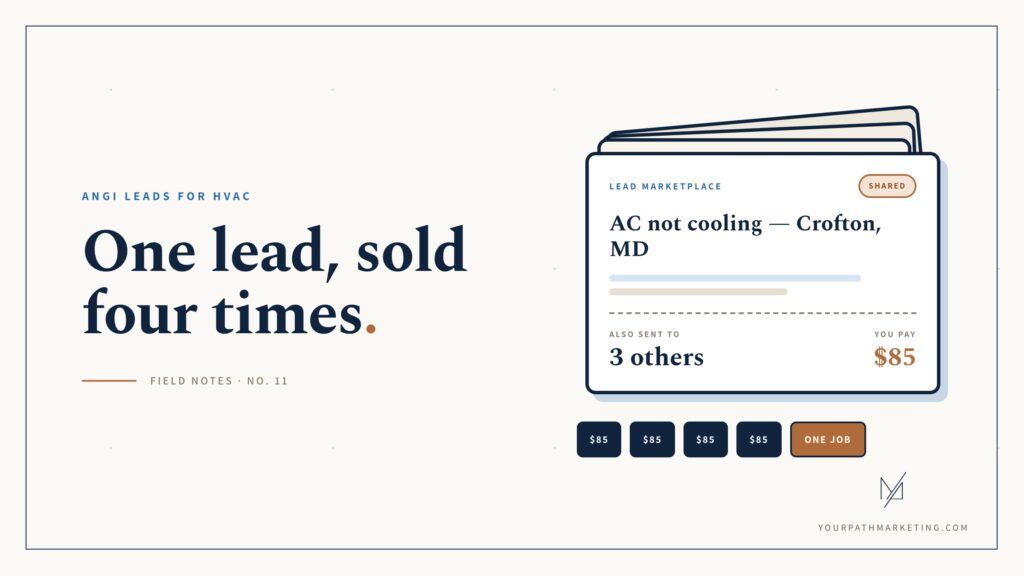
Angi is a lead marketplace. A homeowner fills out a request, and the platform sells that request to contractors. The industry calls what changes hands “leads.” Here’s what it is in plain terms: a phone number and a job description, typically sold to 3 to 8 companies at the same moment. You pay when you receive it, not when you win it.
One piece of corporate housekeeping that clears up a common question: Angi, HomeAdvisor, and Handy are all the same company. If you’ve been pitched by two of them, you’ve been pitched by one of them twice.
So when a rep says the platform sends millions of homeowners to local pros, that’s true. What matters to you is narrower: how many of the requests you personally pay for turn into jobs on your schedule, and what each of those jobs cost by the time you booked it.
How much do Angi Leads cost for HVAC?
Here’s the first thing to know: Angi doesn’t publish a standardized price list. Pricing is negotiated contractor by contractor, which means the only way to get a number is to get on the phone with a sales rep. The ranges below reflect contractor-reported data and current industry reporting, verified August 14, 2026: roughly $15 to $85 per contact for HVAC work depending on the job type and your market, sometimes topping $100 in the tightest metros, plus an annual membership fee of about $300, on advertising terms that typically run 12 months. Prices in tight metros ride an auction, which means they climb when demand does. Industry reporting has HVAC contacts that ran around $40 a few years ago now landing at $65 to $85 in major markets. Verify your own numbers against your own invoices; that’s the entire theme of this article.
But the sticker is not the cost. The cost is what a booked job runs you after the sharing math. You pay for every contact whether or not you win the race to the driveway, so your true cost per booked job is the contact price divided by your win rate. Here’s what that looks like:
| Contact price | You win 1 in 3 | You win 1 in 5 | You win 1 in 8 |
|---|---|---|---|
| $25 | $75 per booked job | $125 per booked job | $200 per booked job |
| $50 | $150 per booked job | $250 per booked job | $400 per booked job |
| $85 | $255 per booked job | $425 per booked job | $680 per booked job |
True cost per booked job = contact price ÷ win rate, before the annual membership fee. Your win rate loosely tracks how many companies got the same request and how fast you called back. Contact price range from contractor-reported data, verified August 14, 2026; check current figures on your own account.
Run your own row: last month’s platform spend divided by jobs you actually booked from it. If you’ve never done that division, do it before your next invoice. On a maintenance ticket, $400 per booked job is a loss. On a $12,000 replacement, it might be the best money you spent all year. The platform doesn’t know which one you’re getting. Your math does.
The FTC record
In April 2023, the Federal Trade Commission finalized an order against HomeAdvisor, the company that does business as Angi Leads, requiring it to pay up to $7.2 million. The FTC’s complaint alleged that since at least mid-2014, the company made false, misleading, or unsubstantiated claims to service providers about the quality and source of the contacts it sold, and about how often they turned into actual jobs.
We’re not going to editorialize on that, because we don’t need to. The takeaway is operational: never let a sales rep’s conversion numbers stand in for your own. Track what you paid, track what you booked, and let your spreadsheet be the only testimonial that counts.
When Angi Leads is actually worth it
Here’s the part the takedown articles skip. There are three situations where buying contacts is a rational move, and if you’re in one of them, nothing in this article should talk you out of it.
You’re new and the schedule is empty. Owned visibility takes months to build. A brand-new company can’t eat months. The platform makes the phone ring this week, and this week is what a new company needs.
You’re expanding into a new service area. In the towns where you have no reviews, no map presence, and no reputation yet, bought contacts buy you time while the real assets get built.
You’re bridging a shoulder season. A slow April or October is a cash-flow problem with a deadline. Turning contact volume up for six weeks and back down is a legitimate use of a dial that turns both ways.
Notice what all three have in common: an end. Each one is a bridge to somewhere. The platform becomes a problem only when it quietly becomes the destination, which is exactly what its 12-month terms and auto-renewals are designed to encourage. If you use it, use it with a taper plan written down on day one. We made the same argument about the whole category in our HVAC marketing ideas breakdown: a bridge, not a home.
Exclusive HVAC leads: better sticker, same landlord
Somewhere in your research you’ll find sellers offering exclusive HVAC leads: the contact goes to you and only you, at a higher price. Industry reporting puts exclusive contacts at 2.5 to 3.5 times the shared price. Exclusivity fixes the worst part of the shared model. You’re no longer the fourth truck pulling up to a driveway where three competitors already parked, and everyone paid for the trip.
It’s genuinely better math in many cases. It is still rent. The reviews, the rankings, and the homeowner relationship still belong to the seller’s system, and the price still rises when your market tightens. Before you buy hvac leads from anyone, exclusive or shared, ask one question and get the answer in writing: who else receives this homeowner’s information, and when. The quality of the answer tells you most of what you need to know about the seller.
The best HVAC lead generation companies, ranked honestly
If you’re comparing hvac lead generation companies, here’s the field as we’d rank it for an independent shop, including the option that pays us nothing and the one that pays us directly. You deserve to know which is which.
1. Google Local Services Ads. The closest substitute for Angi, and better behaved: you pay per contact, the contact is yours alone, there’s a built-in dispute process for bad ones, and ranking runs on your reviews and response speed rather than a pure auction. If you’re going to rent calls, rent them here first. Full mechanics and costs in our LSA guide.
2. Owned visibility. Your Google Business Profile, reviews, and pages that answer real questions, working as one system. Slowest to start, and the only option on this list where stopping payment doesn’t silence the phone. Full disclosure: this is what we sell, our pricing is published, and everything is month to month after the first 90 days, so judge the incentive accordingly. The plain-language breakdown is in local SEO for HVAC companies and the SEO basics guide. If you want to see what you already have before spending anything, the free visibility audit shows your standing in every town you serve.
3. Angi Leads. Everything above. Rational as a bridge, expensive as a home, and now you have the table to price it.
4. Thumbtack. Same shared-contact model, different auction, historically more weighted toward smaller-ticket work. The math worksheet in this article applies unchanged; only the invoice logo differs.
5. Networx and similar smaller marketplaces. Same model again, smaller homeowner pool. Contractor review patterns for these platforms skew heavily toward complaints about contact quality and refund friction. Those reviews are self-selected, so read them as a warning label rather than a survey, and apply the same in-writing question about sharing before you sign anything.
6. Exclusive-contact sellers. Better sticker honesty than the marketplaces, still rented visibility. See the section above.
The pattern across all six: the better the option, the more of the asset you own. The longer comparison of paid channels against each other lives in SEO vs PPC vs LSAs and what HVAC clicks really cost.
How to cancel Angi Leads without a cliff
If you’re past deciding and just want out, here’s the exit, and there’s no pitch in this section.
First, find your term end date and your renewal notice window. Angi advertising agreements typically run 12 months, and industry guides report they auto-renew unless you cancel well in advance, commonly 60 or more days before the term ends, with price increases possible at renewal. The same guides put early-termination penalties at roughly 30 to 35 percent of the remaining contract value. Pull up your agreement or call and ask for both dates in writing before you change anything. Check the current terms in your own account documents rather than anyone’s summary, including ours.
Second, turn the volume down before you turn the account off. Contact volume is adjustable. Reducing it costs nothing, keeps your account intact, and starts shrinking the invoice while you build the replacement.
Third, time the exit to your season. Leaving in the first week of a heat wave means paying the platform’s highest prices right up until you didn’t need them. Leaving at the start of a shoulder season, with reactivation messages going out to your past customers, is leaving on your own schedule.
Fourth, have 90 days of owned-visibility work underway before the last invoice. Profile complete, review habit running, listings consistent, real answers on your site. Whether you do that work yourself or hire it out matters less than the sequence: build first, cancel second. The cliff only exists if you jump before the bridge is built.
The weekly math, forever
Whatever you decide, keep one habit: every week, divide what you spent on bought contacts by the jobs they actually booked. That single number, your cost per booked job, settles every argument in this article for your specific company, in your specific towns, at your specific ticket sizes. It’s also the number worth watching in the background: BrightLocal’s 2026 consumer survey found homeowners using AI tools for local recommendations jumped from 6% to 45% in a single year. The surfaces where people find you keep multiplying, and every one of them reads the assets you own, not the contacts you rented.
FAQ: Angi Leads for HVAC
Is Angi Leads legit?
Yes, it’s a real marketplace that sends real homeowner requests. Legit and worth it are different questions. The FTC’s 2023 order over the company’s marketing claims is exactly why you should judge it by your own booked-job math instead of anyone’s pitch.
How much do Angi Leads cost for HVAC companies?
Roughly $15 to $85 per shared contact, sometimes more in tight metros, plus an annual membership around $300 (contractor-reported ranges, verified August 14, 2026; Angi doesn’t publish standard pricing). Your true cost is per booked job, not per contact: divide the price by your win rate, and expect several times the sticker.
How do I cancel Angi Leads?
Find your term end date and renewal notice window in writing first, since agreements typically run 12 months and auto-renew unless canceled well ahead of the deadline. Turn contact volume down before canceling outright, time the exit to a slower season, and have your owned visibility work running 90 days before the final invoice.
What’s the difference between Angi and HomeAdvisor?
Ownership, nothing more. Angi, HomeAdvisor, and Handy are the same company, and Angi Leads is the pro-facing product that grew out of HomeAdvisor.
What’s the best HVAC lead generation company?
Reframe the question: the best seller of calls is the one you need least. If you’re renting, Local Services Ads behave best. If you’re building, owned visibility is the only option that keeps working after you stop paying.
Whichever month you’re reading this in
The August invoice and the November renewal notice are the same fork in the road: keep renting, or start owning. Both can be right, in sequence. Use the bridge while you need it, run the weekly math so you know the day you stop needing it, and put every dollar you can into the version of visibility that has your name on the deed.
If you want to know exactly how far along your owned visibility already is before you touch anything, the free visibility audit maps it: your rankings in every town you serve, your profile against the competitor winning your market, and whether AI tools recommend you or them. One page, two business days, yours either way, and since we work with one HVAC company per service area, it also tells you whether your towns are still open. Here’s how the rest works.