
Somebody at the supply house counter tells you a shop two counties over sold for five times earnings. You nod. You do the math in the truck on the way back. And then you carry that number around for a year, because nobody told you five times what.
Here is the short version of this whole article. Most independent HVAC shops sell on a multiple of earnings, not revenue. Owner-operated shops land in one range, larger companies with a management layer land in a much higher one, and the gap between them is decided less by size than by whether the business runs when you are not standing in it. HVAC business valuation is not complicated math. It is just math nobody bothers to explain to the people who need it most.
One thing to get out of the way first. We are not business brokers, appraisers, or attorneys, and nothing here is a valuation of your company. This explains how the math works and who published the ranges, so that when someone quotes you a number you can tell whether it makes sense. A real valuation comes from a qualified appraiser or an M&A advisor, and if you are seriously thinking about selling you want one before you talk to a buyer, not after.
Worth knowing about the sources too. Most of the firms publishing these ranges are M&A advisors who get paid when a business sells, which shapes what they emphasize. Every range below is attributed and dated so you can weigh it yourself. We have our own interest in one section near the end, and we flag it when we get there.
Why the number at the supply house is always wrong
Bob got five times. Five times of what, though. There are two different earnings numbers in this business and they are not close to each other.
SDE is seller’s discretionary earnings. It is what the business puts in one owner’s pocket: net profit, plus your salary, plus the personal expenses you legitimately run through the company. It assumes the buyer is a person who will do your job. That is why it is used on smaller owner-operated shops.
EBITDA is earnings before interest, taxes, depreciation, and amortization. It strips out financing and tax choices, and critically, it assumes a hired manager is running the place at a market salary. That is why it takes over once there is a management layer. Buyers normalize owner pay to what a general manager would actually cost, commonly $150,000 to $300,000 depending on size and geography.
Same business, two numbers, two different multiples applied to them. A shop with $450,000 of SDE might have $250,000 of EBITDA once a manager’s salary comes out. Three times SDE and three times EBITDA are separated by $600,000 on the same company. So when a number gets quoted at the counter, the useful question is not what multiple. It is which earnings number, and who agreed to it.
That second half matters more than owners expect. The multiple gets negotiated in public and the earnings number gets negotiated in private, and a buyer can take value out of a deal twice: once by lowering the earnings he will accept, and again by applying a smaller multiple to it.
What buyers are paying, by size
Earnings tier sets the room you are standing in. Everything else decides where in the room you stand. Here is the ladder, with sources and dates, because these numbers move.
Owner-operated, roughly under $1M of earnings. Auctus Capital Partners puts these at 2.6x to 3.5x SDE as of August 2026. Auxo Capital says roughly 2.5x to 4.0x SDE, July 2026. Peak Business Valuation, working from transaction data, comes in lower at 2.40x to 3.40x. Translated into EBITDA terms, Ad Astra Equity puts sub-$1M EBITDA shops at 3.0x to 4.5x, June 2026.
$1M to $3M of EBITDA. Ad Astra puts this band at 5.0x to 7.0x. Sofer Advisors, June 2026, describes the same territory as 5x to 7x for mid-market companies with real recurring revenue and management depth, against an overall HVAC range of 3x to 7x.
$3M to $10M of EBITDA. 7.0x to 10.0x, per Ad Astra. This is platform-quality territory, and it is where the competitive bidding starts.
Above $10M. Multi-trade platforms regularly clear the mid-to-high teens. Almost nobody reading this is here, and it matters anyway, because those are the numbers in the press releases that make the rest of the market feel underpriced.
Two honest cautions about that ladder. The sources do not agree, and the spread is real: on SDE alone, published ranges run from 2.40x at the low end to 4.0x at the high end depending on whose data you read. Anyone who gives you one number without a range is selling something. And the eye-catching sector averages, like the 10.9x HVAC M&A average Ad Astra cites from Capstone Partners for 2025, are pulled upward by large platform recapitalizations. They are not what a ten-truck residential shop gets offered.
Two worked examples
Every number below is invented. The point is the arithmetic and the order it happens in, not the figures.
Example one: a residential shop at $450,000 SDE. Net profit $210,000, owner salary $180,000, documented personal expenses $60,000. That is $450,000 of SDE. At the low end of Auctus’s range, 2.6x, the business is worth $1,170,000. At the high end, 3.5x, it is worth $1,575,000. Same earnings, $405,000 of difference, and that difference is the whole subject of the next section.
Call it 3.0x for the example, so $1,350,000 of enterprise value. Now subtract what the business owes. Truck notes and an equipment loan totaling $185,000 come off, leaving $1,165,000 of equity value. That is the number that belongs to you, and it is already $185,000 below the headline.
Example two: a shop at $1,200,000 EBITDA. This one has a general manager, a service manager, and about 3,000 maintenance agreements on the books. Owner pay has been normalized to a $200,000 GM salary, so the $1.2M is what a buyer would actually inherit. At 6.0x, the midpoint of the $1M to $3M band, that is $7,200,000 of enterprise value. Net debt of $600,000 comes off, leaving $6,600,000 of equity value.
Hold onto that second one. We come back to it, because $6,600,000 of equity value can mean two very different wire transfers.
What moves you inside the range
The tier is mostly a function of how big you already are, which you cannot change quickly. Where you land inside the tier is a different story, and it is where the $405,000 in the first example actually lives.
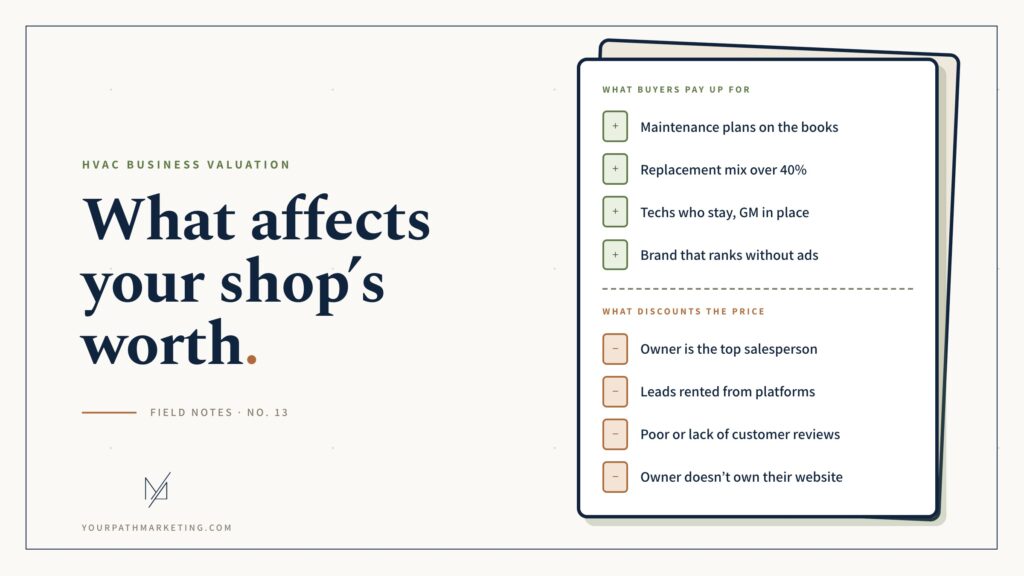
- Recurring revenue. The single strongest modifier. Sofer Advisors puts the premium at 0.5x to 1.5x added to the base multiple for a strong maintenance contract base, and illustrates it with two shops at identical $500,000 earnings, one at 5.5x and one at 3.5x, a $1,000,000 difference. Our article on building and pricing a maintenance agreement covers how that book gets built.
- Owner dependency. Sofer puts the discount at 15% to 25% of value for a business that only runs when the owner is present. A shop like that is a unit somebody has to jump with a screwdriver every time it starts. It works. That does not make it something a buyer wants to own.
- Customer concentration. Anything much over 10% to 20% of revenue from a single customer gets priced as risk, and it is the most common trigger for an earnout rather than cash.
- Crew and foreman tenure. The buyer is purchasing the ability to keep doing the work after closing. Technician turnover and license depth get examined directly, and every tech’s EPA Section 608 certification needs to be on file, because missing paperwork has killed deals outright.
- Service mix. Replacement and service price better than new construction, and heavy exposure to one builder prices worst of all. Breakwater M&A notes that companies with more than half of revenue from service and maintenance command higher multiples than installation-heavy shops.
- Clean books. Normalized owner compensation, documented add-backs, and financials that survive a quality of earnings review. An add-back without a paper trail gets rejected, and every rejected add-back comes straight off the earnings number the multiple gets applied to.
Notice what those six have in common. Every one of them is about whether the business is a system or a person. That is the actual question behind the multiple, and it is why two shops with the same revenue and the same trucks get offers that are hundreds of thousands of dollars apart.
Why the maintenance book gets its own look
Recurring revenue is one modifier among several. The agreement book is also its own line item in diligence, and it gets tested rather than taken on faith.
Buyers ask for three things: how many active agreements, what share renewed last year, and revenue per agreement. Ad Astra’s worked example of a residential seller in a top-50 market describes an agreement base with under 8% annual member attrition as the single highest-weighted driver in the underwriting, supporting a 9.0x multiple. Attrition under 8% is another way of saying a renewal rate above 92%.
Almost nobody can produce that number on request. Agreement count, sure, everyone has that. Renewal rate is the one that sits in the software untouched, and it is the one a buyer will ask for in the first month of diligence. If you read one thing on this site and act on it, make it that: pull your renewal rate this quarter, whether or not you ever intend to sell.
Who is actually buying, and why they pay what they pay
The names are public. Apex Service Partners, backed by Apollo. Wrench Group, backed by Leonard Green. Sila Services, backed by Goldman Sachs Alternatives. Service Logic, ARS, Authority Brands, Redwood Services, Champions Group. Below the platform tier sit twenty or more sub-platforms doing the actual volume of small acquisitions.
The distinction that explains price is platform versus add-on. A platform has to stand on its own with its own management, so it gets bought at the high multiples that make the trade press. An add-on plugs into infrastructure the buyer already owns, which is why the same shop is worth more to a group already operating in your county than to one trying to enter it. If a platform has bought three companies around you, you are worth more this year than you were two years ago, and less once they have bought the fourth.
This is also the mechanism behind the corporate-owned competitors wearing local branding that you have watched appear in the metro. The name on the truck stays. The ownership does not.
Three kinds of buyer, and why it matters which one you take
An individual or a search fund. Often financed through an SBA loan. Usually the lowest multiple, usually the most seller-note risk, and usually the buyer who keeps running it as the business you built. Someone doing your job, for your customers, under your name.
A local competitor or strategic buyer. Middle of the range. Public strategics tend to pay near-100% cash at close with little or no rollover, which is a cleaner exit at a slightly lower headline. Operations often get merged, which is a real consideration if you care what happens to your crew.
A private-equity-backed platform. The highest headline multiple, and the most structure attached to it. The reason the multiple is highest is not that your shop is special. It is that they are buying scale, and your trucks in your county are a piece of it.
Now the part that usually goes unsaid on marketing websites. Selling to a person who keeps the name and the crew is a genuinely different transaction from selling into a roll-up, and neither one is a moral failure. An owner who took the best offer on the table to fund a retirement he earned over thirty years does not need a lecture from anybody, least of all from us. What he needs is to understand what he is signing, which is the next section.
The headline is not the check
A nameplate says four tons. What comes out of the registers after duct losses is a different number, and every owner reading this knows the difference. A purchase price works the same way.
Auxo Capital lays out the sequence plainly: buyer-accepted earnings times the multiple equals enterprise value; enterprise value minus net debt and working capital adjustments equals equity value; equity value minus escrow, seller notes, earnouts, and rollover equals cash at closing. Four subtractions between the number in the press release and the number in your account.
Rollover equity. Rollover equity means you keep a stake in the buyer’s platform instead of taking cash. Ad Astra reports it as effectively mandatory at Apex, Sila, Wrench, and Service Logic, typically 10% to 20%, held through a three-to-five-year run at the next exit. Other trackers put the typical rollover higher, at 15% to 30%. Either way, that slice of your price is a bet on somebody else’s execution across dozens of companies you will never see.
Cash at close. Here the sources genuinely disagree, and the disagreement is worth more to you than any average of it. Ad Astra cites IBBA data putting HVAC cash at close at 75% to 90%, with platform-quality add-ons at 80% to 85% and sub-$1M tuck-ins at 65% to 75%. Deal Prospectors, June 2026, reports a typical private-equity structure of 50% to 70% cash. CT Acquisitions, June 2026, splits the difference at 60% to 80%.
Run that against example two. On $6,600,000 of equity value, 80% cash at close is $5,280,000 wired at signing. At 60%, it is $3,960,000. Same headline, same business, and $1,320,000 of difference in what you actually take home on day one. A lower multiple with better cash at close beats a higher multiple with a long earnout more often than owners expect.
Seller notes and earnouts. Seller notes are common on smaller SBA-driven deals, where Ad Astra puts sub-$1M tuck-ins at 15% to 25% carried by the seller. Earnouts show up specifically when customer concentration runs above 20% or when the owner plans to leave inside twelve months. Both mean you are financing part of your own sale.
The working capital peg. The least glamorous item on the list and the most common source of friction after exclusivity. Negotiate it before the letter of intent is signed, not after, because after exclusivity you have lost every alternative you had.
What a buyer looks at online
This is what we do for a living, so read this section knowing that. It is also a real diligence category, and it is short on purpose.
An acquirer is buying the phone ringing after the founder stops answering it. Four things get checked. Whether reviews name you personally or name the company, because thirty years of reviews praising one man is an owner-dependency finding, not a strength. Whether branded searches for your company name show real volume in Search Console, which is the closest thing to demand you are not renting. Whether the website, the domain, and the Google Business Profile are legally owned by the business rather than by a former marketing vendor. And whether your name, address, and phone match across Google, Bing, your manufacturer dealer pages, and the directories.
That third one is not hypothetical. Owners discover mid-diligence that a vendor holds the domain, and it removes leverage at the exact moment leverage is worth the most. Our owner’s guide to search visibility and the local search page cover how to check all four.
The things that take three years to fix
Nothing here is an argument to sell. It is an argument that the levers move slowly, so the time to pull them is before the call comes rather than after.
Three of them carry the most weight for a small shop. Build the agreement book, and track renewal rate from the day you start. Get the business to run without you for a full week, which is the fastest test of the owner-dependency discount you will ever run and costs nothing but nerve. And own your own digital assets outright, which is a one-afternoon audit that occasionally turns up something expensive.
Every one of those makes the business better to run whether or not you ever sell it. That is the reason to do them. The higher multiple is a side effect.
Frequently asked questions
How much is my HVAC business worth?
It depends on your earnings and which earnings number applies. Owner-operated shops commonly transact between 2.4x and 4.0x SDE depending on the source, and companies with a management layer are priced on EBITDA at higher multiples. Only a qualified appraiser or M&A advisor can value your specific business.
What multiple do HVAC companies sell for?
Published 2026 ranges put sub-$1M EBITDA shops at 3.0x to 4.5x, $1M to $3M EBITDA at 5.0x to 7.0x, and $3M to $10M at 7.0x to 10.0x. Higher sector averages you may see reported are inflated by large platform recapitalizations.
What is the difference between SDE and EBITDA?
SDE adds your salary and documented personal expenses back to profit, because it assumes the buyer will do your job. EBITDA assumes a hired manager at market pay, so that salary stays as a cost. Smaller shops are priced on SDE, larger ones on EBITDA.
Do maintenance agreements increase the value of an HVAC company?
Yes, substantially. Sofer Advisors puts the premium at 0.5x to 1.5x added to the base multiple for a strong contract base. Buyers test agreement counts, revenue per agreement, and renewal rate in diligence, so the book has to be documented rather than described.
Why do private equity buyers pay more for HVAC companies?
Because they are buying scale rather than your shop specifically, and an add-on plugging into infrastructure they already own is worth more to them than to a buyer entering your market. They also attach more structure, including rollover equity and earnouts, which lowers the cash you take at closing.
How long does it take to sell an HVAC business?
The sale process commonly runs six to twelve months from going to market through closing. The preparation that actually moves the price, building recurring revenue and reducing owner dependency, takes two to three years, which is why advisors recommend starting twelve to twenty-four months out at minimum.
Know the number before somebody else names it
You are not being asked to sell anything. You are being asked to know what you have, so that when a polite stranger calls with a number you can tell whether it is a good one. HVAC business valuation comes down to two questions: which earnings number the buyer accepted, and how much of the price is actually cash at closing. Everything else in this article is detail underneath those two.
And if you would rather know where you stand online before any of that becomes urgent, that is what the free visibility audit is for: your rankings in every town you serve, your profile against the competitor winning your market, whether your reviews and listings would survive you stepping back, and whether AI tools name you or them when a homeowner asks who to call. One page, two business days, yours either way. We work with one HVAC company per service area, so it also tells you whether your towns are still open. Here is how the rest works. Worth a look?