
It’s late October. Somewhere in the next three weeks you’ll write down a number for next year, and three different companies have already told you three different things to do with it.
One wants more ad budget. One wants a retainer. One sent a proposal with a percentage on it.
This article is about none of those pitches. It’s about the shape of the bill. SEM for HVAC companies, which is just the umbrella term for all of it, paid and organic together, breaks into three channels with three genuinely different cost curves. Once you can see the curves, the split is obvious, and you can do the math with your own ticket sizes instead of somebody else’s percentage.
We don’t sell ads of any kind. Our fee is the same whether your ad budget is zero or ten thousand a month, which is the only reason to trust anything below.
How much should an HVAC company spend on marketing? The Air Conditioning Contractors of America surveyed more than 1,000 contractors and found the average spends 6% of annual revenue on marketing and advertising. The ones investing at least 12% report net profits of 9%, against 5% for everyone else. Useful numbers. Still the wrong place to start, for reasons below.
Is SEO, PPC, or LSAs the best use of an HVAC marketing budget? It depends on how high your floor already is. A company with no visibility has to rent calls to get any. A company with a strong profile and real reviews gets cheaper calls from every channel, including its ads. Four situations are mapped further down.
Everyone’s answer is a percent
Search for how to budget sem for hvac companies and you’ll get percentages. Agency guides mostly land on 7 to 10% of revenue, pushing to 12 to 15% in growth mode. It’s fair to be suspicious of that, since almost every one of those guides was written by a company paid out of the budget it’s recommending.
So we went and checked, expecting to find the industry advice running hot.
It isn’t. ACCA’s Contractor of the Future study, built from more than 1,000 HVACR contractors in partnership with Farmington Consulting Group, found the average contractor spends 6% of annual revenue on marketing and advertising, and that contractors investing at least 12% see net profits of 9% against 5% for those spending less. That’s a trade association with nothing to sell you, landing near the same number as the agencies.
Credit where it’s owed. On the marketing budget percentage of revenue question, the people with an incentive to inflate the number appear to be roughly right.
Two things worth holding alongside that, though.
Correlation is not causation. Profitable companies can afford to spend 12%. It’s at least as plausible that good margins fund big budgets as the reverse. And spending more only pays if the phone gets answered and the trucks show up, which is a capacity question, not a marketing one.
A percent budgets backward. Six or twelve percent of last year’s revenue tells you what you can afford based on where you already are. It says nothing about what a booked job costs to buy in your market, which is the only number that decides whether the spending works. That’s cost per booked job, and it budgets forward.
One question worth asking your marketing company before you ask them anything else: how are you paid? A firm billing a percentage of your ad spend has a structural interest in your ad spend going up. That isn’t corruption, it’s incentive design, and it explains a lot of what you’ll read this month. We charge a flat retainer and sell no ads, so the honest answer for us is that we gain nothing either way from where this article lands.
The three channels, in one paragraph each
Each of these has its own full article, because each deserves one. Here they are at the altitude this decision needs.
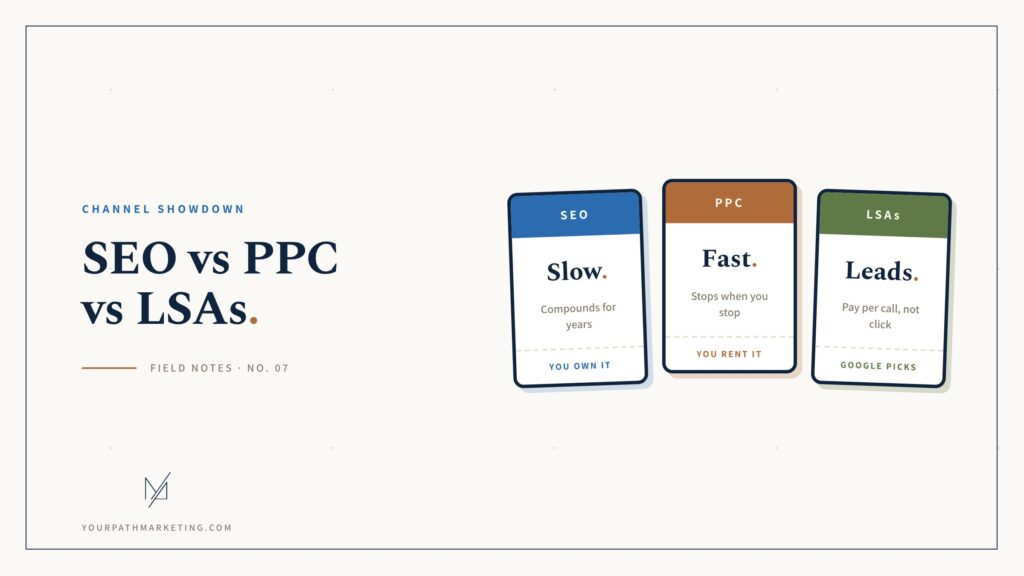
PPC. Rented clicks, priced by an auction, indifferent to whether anyone calls. You pay when someone clicks, booked job or not. What HVAC clicks really cost, and when they stop paying.
Local Services Ads. Rented contacts, and the cheapest paid channel in this trade. You pay per call or message rather than per click, and your placement runs on your reviews and your response speed. The full LSA breakdown.
Organic and local search. Owned visibility. Slow to start, and it doesn’t stop when you stop paying. Your Google Business Profile, your reviews, your service pages. The plain-language playbook and how local search actually works.
Worth noting which of those ACCA’s contractors say actually produces customers. In that same study, the top sources named were Google Business profiles first, then company websites, then paid digital ads. The free listing beat the paid channels, according to the contractors themselves.
Three channels, three different cost curves
Here’s the part nobody puts in a proposal. Every quote you’ll get for sem for hvac companies is a monthly number, which quietly implies all three channels behave the same way. They don’t. They cost differently as you grow.
PPC is linear and indifferent. Every click costs whether or not it becomes a customer. Double the clicks, double the bill, and your cost per booked job stays roughly flat or rises as the auction heats up. SearchLight’s 2026 benchmark, built from $14.9 million in HVAC and plumbing search spend, put non-branded search around $149 per contact.
LSAs are linear but honest. You pay per contact, so the cost scales with something real. Their LSA benchmark, covering $6.72 million in spend across 888 contractors, put HVAC around $51 per contact with a book rate near 44%, and a cost per paying customer near $233 across home services. Better than PPC. Still linear: 40 customers costs four times what 10 costs.
Organic is fixed. A retainer is the same number whether the work produces 10 booked jobs that month or 40. Which means cost per booked job falls as it compounds, and keeps falling.
Run it with real numbers. Say you’re spending $3,000 a month either way, and assume the benchmarks above hold in your market.
At 10 booked jobs a month: the retainer costs you $300 per job. LSAs at roughly $233 per paying customer, the home services average, cost about $2,330, which is genuinely cheaper.
At 40 booked jobs a month: the retainer still costs $3,000, so $75 per job. The same 40 customers through LSAs runs about $9,320.
That’s the whole argument in two lines. Paid channels get more expensive as you grow. Owned visibility gets cheaper as you grow. It isn’t a preference or a philosophy. It’s the shape of the bill, and it’s why the seo vs ppc for hvac debate usually gets framed wrong: they aren’t competing for the same job.
The crossover, honestly
Now the part that argues against us.
In month one of a retainer, your cost per booked job from organic is effectively infinite. You paid, and nothing has ranked yet. Month two isn’t much better. The curve only bends somewhere in the back half of the first year, and where exactly depends on how competitive your market is, how much of a profile you started with, and how patient you can afford to be.
So there is a crossover point, and it is not in the same place for everybody.
In a small market, with a strong profile and a good review base, LSAs may simply stay cheaper than a retainer for a long time. If you need calls next month and you can answer the phone, rent them. That’s a rational decision and any article that tells you otherwise is selling something.
What owned visibility buys is a floor: what the phone does every month without you paying more for it. Paid buys peaks, rented when you need a spike. And the two are connected, because LSA placement runs on reviews and response speed, which are the same assets that build the floor. An owner with a high floor rents fewer peaks and pays less for the ones they rent.
Four situations, four splits
No universal percentages here, because your ticket sizes decide it. But the shape of the answer changes a lot depending on which of these you are.
You’re new, or new to a market. Rent heavily and build underneath it. You have no floor, so ads are the only thing that makes the phone ring this month. Just be honest that it’s a bridge, not a business model, and start the owned work in parallel on day one instead of after the ad budget disappoints you. Measure: cost per booked job, and whether it’s falling.
You’re established, visibility is weak, and the phones went quiet. The hardest case and the most common one. Split it, and plan for the paid share to shrink over a year as the floor rises. The mistake here is treating the paid spend as permanent instead of as a bridge you’re actively building out from under. Measure: paid share of total booked jobs, month over month. It should be declining.
You’re established, with strong reviews and a good map position. Cut PPC first, since it’s the channel your floor already replaces. Keep LSAs for peak weeks. Protect the floor, because it’s the cheapest customer acquisition you will ever have and it’s the thing that lowers your LSA price too. Measure: what happens in a week you pause the ads. If nothing changes, you found your answer.
You’re at or near capacity. The situation nobody writes about. If you cannot take the work, stop buying it. Paying for calls that ring out or get scheduled three weeks later is worse than not advertising, because it costs money and it costs reputation. Bank the season, put the money into the floor, and come back to ads when you’ve got trucks. Measure: your answer rate and your time to first callback.
Why this is an October decision
Two clocks are running while you set this number, and they run at different speeds.
The first one is nearly out of time. Using NOAA’s 1991 to 2020 climate normals, University of Maryland Extension puts a 10% chance of hitting 32 degrees by October 13 and a 90% chance by November 15. Somewhere in that window, half the furnaces in your service area run for the first time in seven months and a predictable share of them fail. Paid is the only lever that moves fast enough to catch it. If you want to be visible for that, the hvac advertising budget decision is now, not in December.
The second clock is slower and it’s the one most owners miss. Content and local visibility take roughly two to four months to rank, which means the searches that pay you next summer are earned by what you fund this month. Nobody feels urgency about July in October. That’s exactly why the companies who own July in July started paying attention around now.
Rent the winter you’re standing in. Build the summer you can still influence.
Common mistakes
The mistake: Setting the hvac marketing budget as a percentage of last year’s revenue.
The fix: That budgets backward from where you already are. Start from the jobs you want, work back through your close rate and your average ticket, and see what each channel actually costs to deliver them.
The mistake: Taking budget advice from whoever gets paid a percentage of it.
The fix: Ask how they’re compensated before you ask what they recommend. It’s not a rude question, and the answer explains most of the advice you’ll get. It’s also one of twelve worth asking before you sign with anyone.
The mistake: Splitting a small budget evenly across every channel.
The fix: Three thousand dollars spread across ads, LSAs, social, and a retainer is $750 of nothing, four times over. Concentrate until something works, then widen.
The mistake: Judging all three channels on the same timeline.
The fix: Ads report next week. Owned visibility reports next quarter. Judging a retainer at 30 days is how owners quit three weeks before it starts working.
FAQ: splitting an HVAC marketing budget
How much should an HVAC company spend on marketing?
ACCA’s study of more than 1,000 contractors found the average is 6% of annual revenue, and that contractors investing at least 12% report net profits of 9% against 5% for lower spenders. Use that as a sanity check on your range, then decide the actual number from your target cost per booked job and your capacity to handle the work.
Should I do SEO or PPC first?
If you need calls this month and have no visibility, ads first, with the owned work starting in parallel. If your phone still rings and you’re planning a year out, the floor first. The seo vs ppc for hvac question is really a question about how long you can wait.
Are LSAs better than SEO for HVAC?
For immediate cost per contact, usually yes. For cost per booked job at scale, usually no, because LSA costs rise with volume and a retainer doesn’t. They also aren’t really alternatives: your reviews and response speed set your LSA placement, so the owned work makes the rented channel cheaper.
What is SEM, and do I need it?
SEM stands for search engine marketing, and it’s the umbrella covering everything in this article, paid and organic together. You’ll see sem for hvac and sem for hvac companies on proposals, usually without a definition attached. You don’t need the word. You need to know which channel you’re buying and what it costs per booked job.
What’s a good cost per booked job for an HVAC company?
One your margin can carry, which depends entirely on your ticket. A common gut check is keeping acquisition under about 10% of the job’s value: $50 on a $500 repair, $700 on a $7,000 replacement. If a channel can’t hit that on repairs, point it at replacements instead.
Should I cut marketing in my slow season?
Cut the paid part if you need to. Don’t cut the owned part, because the slow season is when the floor gets built and it takes months to show up. Companies that go dark every shoulder season spend their whole lives renting.
Decide it with your own numbers
There’s no correct percentage. There’s a floor that pays you every month whether or not you fund it again, and peaks you rent when you need them. Most of the sem for hvac companies conversation is really an argument about which of those you’re buying, conducted by people who don’t say so.
Whatever you decide this month, the floor is the part still working after the budget meeting is over. If you want to see how high yours is right now, the free visibility audit maps where you rank in every town you serve, what that visibility is worth, and whether AI tools name you or a competitor. One page, two business days, yours either way. We work with one HVAC company per service area, so it also tells you whether your towns are still open. Here’s how the rest works, pricing included, published.