
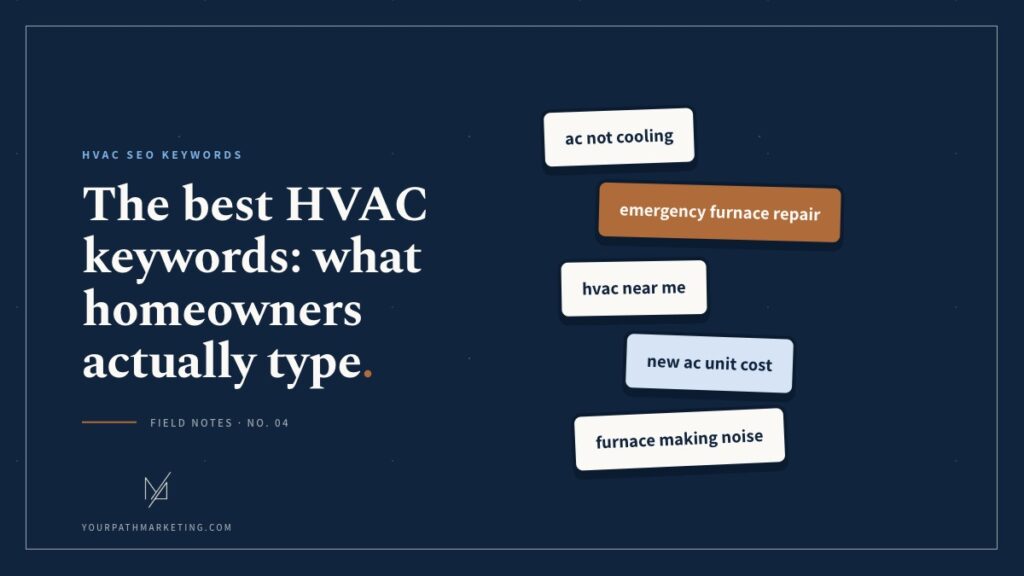
You already know your keywords. You hear them all day.
“It’s blowing warm.” “The furnace won’t kick on.” “How much for a new system?” Those aren’t customer complaints. They’re search queries with a phone attached.
Here’s the thing most articles about the best seo keywords for hvac company owners get wrong: they hand you a list. A list is trivia. What you need is the list sorted by what each search is worth, when it fires, and which page has to earn it. That’s what this is.
We’re starting with heating, and it’s July. Your phone is ringing with AC calls right now, and this article opens with furnaces anyway. That’s not a mistake, it’s the whole method: content takes two to four months to rank, so the pages that win October get written while it’s still 90 degrees out. Cooling comes after. Bank it for spring.
What are the best SEO keywords for an HVAC company? The ones your customers actually say, grouped in three tiers: emergency searches (highest value, won in the map results), replacement searches (biggest ticket, won with pages and reviews), and research questions (won with content and AI answers). Intent and proximity matter more than volume.
How many keywords should an HVAC company target? Fewer than any tool will suggest. A focused list of 15 to 30 real searches across your services and towns beats a spreadsheet of 500. Each one needs a page or a section that earns it. Unearned keywords are just a list.
Your call log is your keyword list
Try this before you open any tool. Read your last 20 calls and write down the words the customer used. Not the words you’d use. Theirs.
You’ll get “blowing warm air,” not “insufficient cooling output.” You’ll get “making a banging noise,” not “compressor fault.” You’ll get “my upstairs is always hot,” which isn’t a diagnosis at all, and is exactly what somebody types into Google at 11pm in July.
That gap is where most HVAC websites quietly lose. Pages get written in technician language for customers searching in kitchen-table language. Both describe the same problem. Only one of them matches the search.
Tools have their place. Google’s Keyword Planner will confirm what your call log already told you and add rough volume estimates, which are estimates, not counts. What tools cannot do is hear how a homeowner in Dundalk describes a dying heat pump. Your techs already know. That’s the asset nobody can buy.
This is the depth we skipped in the HVAC SEO basics article, step four. Start there if you want the whole picture; stay here for the keyword layer.
Once you have the raw list, sort it. The best seo keywords for hvac company websites fall into three tiers, and the tiers are worth wildly different money. Here they are in order of what they pay.
Tier 1: emergency keywords (the ones that pay tonight)
Pattern: problem, plus urgency, plus place.
In heating season, that sounds like: no heat, furnace not working, furnace won’t turn on, heat not working upstairs, furnace blowing cold air, boiler leaking, emergency furnace repair, 24 hour heating repair, furnace repair near me. In cooling season the same shape returns as AC not cooling, AC blowing warm air, AC not turning on, and ac repair near me. Add the modifiers homeowners reach for when it’s bad: “open now,” “tonight,” “same day,” “24 hour.”
These are the most valuable hvac keywords you will ever compete for, and the least mysterious. Nobody comparison shops with a dead furnace. They search, they scan the first screen, they call. Ninety seconds, start to finish.
What decides them: the map results, your proximity, your reviews, and whether a human answers. Not your blog. Emergency hvac keywords do not need articles written about them, and writing one is a classic waste of a weekend.
What they need instead: a complete Google Business Profile, a service page for each emergency problem with a tappable number at the top, and honest hours that say whether you actually answer at 9pm. That’s the whole playbook, and it’s covered properly in local SEO for HVAC companies.
One more thing worth knowing: these are also the most expensive searches on earth to rent. Everyone bids on the emergency moment, which is why HVAC ad clicks cost what they cost. Owning this tier organically is the difference between paying for the 9pm call and simply receiving it.
Tier 2: replacement keywords (the ones that pay for the year)
Pattern: research, plus cost, plus comparison.
This tier sounds like: new furnace cost, how much is a new HVAC system, furnace repair or replace, heat pump vs furnace, high efficiency furnace worth it, what size furnace do I need, HVAC financing, and the entire rebate family. These searches happen weeks before the job, usually at a kitchen table, often with a spouse and a quote in hand.
Heat pump keywords deserve their own paragraph in this market. Maryland is in the middle of a genuine conversion wave, and the money keeps moving. The federal tax credit for air-source heat pumps ended for systems installed in 2026 or later. State and utility rebates through EmPOWER Maryland remain some of the strongest in the country, but April’s Utility RELIEF Act cut the program’s savings targets, and rebate amounts are widely expected to shrink starting in 2027. The same law funds a new Maryland Energy Administration program for lower-income installs that hasn’t launched yet. Every one of those changes sends homeowners straight to Google with a question your competitor probably hasn’t answered. Check current program status yourself before you write the page. It has changed twice in a year, and it’s going to change again.
What decides this tier: pages that answer honestly, with numbers, plus enough reviews to make the numbers believable. A homeowner comparing a $9,000 quote to a $14,000 quote is not looking for marketing. They’re looking for someone who will explain the difference without flinching.
What they need: one page per real decision question. A repair-or-replace page. A cost page with actual ranges and stated assumptions. A heat pump page that mentions rebates and updates when the rebates change. Dollar for dollar, these are the best seo keywords for hvac company revenue, because one page can pay for itself with a single install.
Want to know which of these searches you already show up for, and which ones your competitor owns? The free audit checks that across every town you serve.
Tier 3: research keywords (the ones that build the relationship)
Pattern: a question, asked with no intention of buying anything today.
Why is my AC freezing up. What temperature should I set in winter. How often should I change my filter. What does short cycling mean. Why does my furnace smell like burning dust in October. Is it normal for a heat pump to blow cool air.
Low commercial intent, high trust value, and here’s the twist: this tier is where AI answers now live. Pew Research Center tracked the real browsing of 900 adults and found people clicked a traditional search result on just 8% of searches when an AI summary appeared, versus 15% without one. Question-shaped searches trigger those summaries most often.
Read that plainly: on this tier, you may not get the click. You can still get the mention. And the mention is what surfaces at 9pm in January when that same homeowner’s furnace dies and a name floats up from somewhere. That’s the whole logic of AI search and AEO.
What they need: the answer first, in one or two sentences, then the explanation. That format wins twice, because a homeowner skimming on a phone and an AI engine assembling a summary want exactly the same thing. Give it to me straight.
The seasonal calendar: when each keyword fires
Every keyword above has a season. Timing is the part of choosing keywords for hvac companies that almost nobody writes down, and it’s the part that decides whether the work pays. Here’s the season you should be writing for right now.
Heating: the cold snap is the event. In our market, the freeze window is well documented. Using NOAA’s 1991 to 2020 climate normals, University of Maryland Extension puts a 10% chance of hitting 32°F by October 13 and a 90% chance by November 15. Somewhere in that window, half the furnaces in your service area run for the first time in seven months, and a predictable share of them don’t. Every no-heat search in your towns fires inside about 72 hours. Then December and January bring the sustained peak, with the deep emergency cluster in January.
Cooling: the first 90-degree stretch is the event. Late May or June, usually. Systems that limped through last August fail in the first real heat, and the searches spike within a day. July is the sustained peak. Humidity does its own damage here that drier markets never see: the “it’s cold but clammy” call is a Mid-Atlantic specialty, and almost nobody has a page for it.
The shoulders: March to April and September to October. Emergency searches go quiet. Maintenance, tune-up, and replacement-planning searches rise. This is when the kitchen-table research happens, and it’s the cheapest attention you’ll get all year.
Now the part that makes this a calendar instead of a chart: content takes two to four months to rank. Which means heating pages get written in August, not November. The first cold snap isn’t the moment to start. It’s the deadline.
If you’re reading this in July, you’re early for heating, which is the best thing you can be. Write those pages now and they’ll be ranking when the first furnace fails. Then sketch cooling pages by February. That’s not a marketing rule. It’s just what the weather does, on a schedule, in this particular corner of the map.
Long-tail keywords: the cheap wins nobody wants
Long tail keywords hvac companies ignore are usually the ones sitting there unclaimed.
They look like: a specific brand plus a specific symptom (Carrier furnace code 33), a specific town plus a specific service (heat pump repair Ellicott City), a specific situation (furnace won’t start after power outage), or a specific age question (is a 15 year old furnace worth repairing).
Ten searches a month each. Nearly free to win. And they convert better than anything else on this page, because a searcher that specific is a searcher that close.
The math is worth saying out loud. Twenty long-tail searches at 10 a month is 200 monthly searches you can realistically own this year. One head term at 200 is a search you will not crack against a competitor with 900 reviews and a decade of history. Same volume. Wildly different odds.
What they need: not new pages each. A section inside an existing page, or a short FAQ entry. Ten thin pages about ten variations of one question is how sites get worse, not better.
If you’re building a shortlist of the best seo keywords for hvac company pages to chase this quarter, put two or three of these on it. They’re the ones you can actually win before the snow flies.
Common mistakes
The mistake: Chasing head terms like “HVAC” or “air conditioning” because the volume looks big.
The fix: Half that volume is research and the other half is people looking for HVAC jobs. Chase searches with a problem and a place in them. Smaller number, ringing phone.
The mistake: Writing pages in technician language instead of customer language.
The fix: Use the words from your call log. “Blowing warm air” is a search. “Refrigerant charge diagnostics” is a service ticket.
The mistake: Building a separate page for every keyword variation.
The fix: One page per real customer question. Ten phrasings of the same question belong on one strong page.
The mistake: Writing heating content in November.
The fix: Publish two to four months ahead of the season. You wouldn’t order equipment the morning of the install.
FAQ: HVAC keywords
What are the best SEO keywords for an HVAC company?
The best seo keywords for hvac company websites are the searches your customers already say out loud, sorted into three tiers: emergency problems with a location attached, replacement and cost questions, and research questions. Emergency terms bring tonight’s call, replacement terms bring the year’s revenue, and research questions build the trust that produces both later.
How do I find the keywords my customers actually use?
Read your last 20 calls and write down the customer’s exact words. Then ask your techs what people say when they open the door. That list beats any tool, because it’s in the language homeowners search in, and it includes the local phrasing no database knows about.
Should HVAC companies target “near me” keywords?
You don’t target them so much as earn them. Google decides “near me” by proximity, your business profile, and your reviews, not by putting the phrase on a page. Complete the profile, gather reviews steadily, and the near-me searches follow.
Are zero-volume keywords worth targeting?
Often, yes. Volume tools miss local phrasing and round small numbers to zero. A search with no reported volume that describes a real problem in a real town is usually worth a paragraph, especially since it costs you nothing to answer a question you answer weekly anyway.
Do I need a keyword tool to do this?
No. You need your call log, your service list, and your town list. A tool helps confirm the hvac seo keywords you’ve already identified and spot a few you missed, but it’s a supplement to what you know, not a substitute for it.
When should I publish seasonal HVAC content?
Two to four months before the season, because that’s how long ranking takes. Heating content in August and September. Cooling content in February and March. Publishing in-season means paying with ads for the visibility you could have earned.
Start with the list you already have
The best seo keywords for hvac company owners in this market are sitting in your call log right now, in your customers’ own words, sorted by a season that arrives on a schedule. Nothing in this article requires a tool, a subscription, or a marketing degree. It requires reading your own calls and writing what you already tell people every day.
Start with heating. You have a couple of months, and the hvac seo keywords that matter most in October are the ones you write in July.
And if you’d rather see which of these searches you already win, and which ones a competitor owns in your towns, that’s what the free visibility audit is for. We check your rankings across every town you serve, compare your profile to whoever’s currently taking those calls, and test whether AI tools name you. One page, two business days, yours either way. We work with one HVAC company per service area, so it also tells you whether your towns are still open. Here’s how the rest of it works.