
Somewhere in the next couple of months, you’re going to pick a number for this winter.
Maybe it’s the same number as last year. Maybe your rep suggested a bigger one. Either way, the budget gets set before the first cold snap, and then the phone starts ringing and nobody looks at it again until spring.
Before you pick that number, it’s worth knowing exactly what it buys. LSA for hvac companies works nothing like regular search advertising, and most of what owners believe about it came from whoever sold it to them.
We don’t sell ads of any kind, including these. So here’s the whole thing: the real costs, how the ranking actually works, where it falls short, and the one asset that lowers your price whether you run them or not.
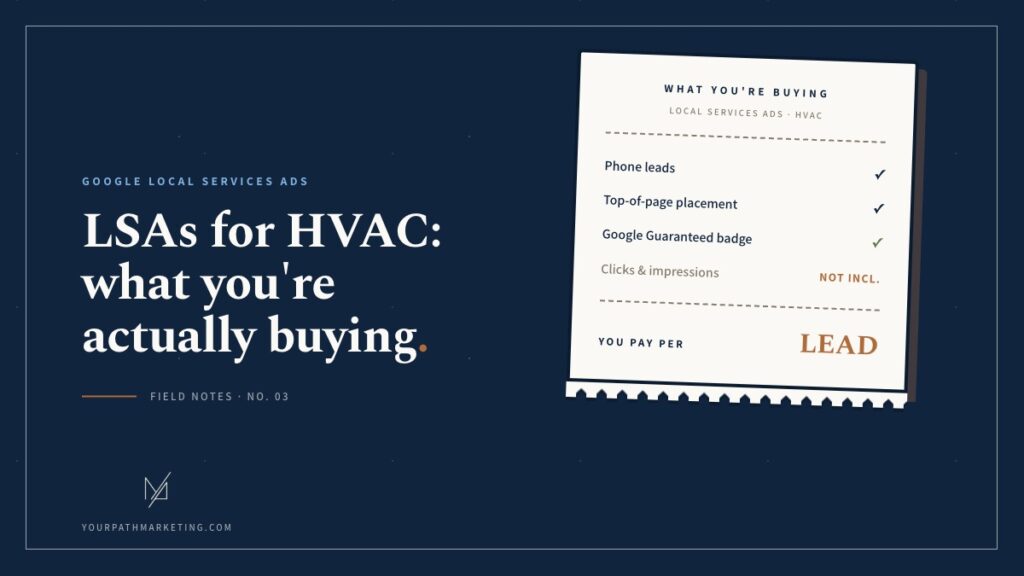
What are Google Local Services Ads? They’re the listings with photos and a green checkmark badge that sit at the very top of the results, above the regular ads and above the map. You pay per contact instead of per click, and you have to pass background and license checks before you can run them at all.
How much do Local Services Ads cost for HVAC? Roughly $51 per contact for HVAC, according to SearchLight’s February 2026 benchmark, which makes them meaningfully cheaper than regular search ads. But the contact price is not the customer price, and the gap between them is the whole story. That’s the next section.
What LSAs actually are
Google local services ads are a different animal from the ads above the fold you already know.
There are no keywords. You don’t write copy. There’s no landing page. You pick your services and your service area, and your profile becomes the ad: your photos, your review score, your hours, your phone number. Google assembles it and decides who shows.
You pay per contact, not per click. A homeowner has to actually call or message you before the meter moves. That’s a real difference from regular Google Ads, where you pay for the click and hope.
Google’s dashboard calls these leads. We’ll call them what they are: calls and messages from people who need a technician.
The green badge is the point. Google guaranteed requires a background check, plus license and insurance verification, and in return Google backs the job for the homeowner up to a capped amount if it goes wrong. That badge is doing quiet work: it’s a stranger’s endorsement at the exact moment a homeowner is deciding whether to let you into their house at 9pm. Check Google’s own documentation for current requirements and guarantee terms, because they vary by market and Google has been changing them.
One quick disambiguation: if you’ve seen “Google screened,” that’s the same idea for lawyers and financial planners. Verification, no money-back guarantee. Not your product.
So the mechanical shape of lsa for hvac companies is less an ad account than a verified profile that Google rents placement to. Which explains almost everything else in this article, including the parts that seem unfair.
What they actually cost
Here’s where this article is going to say something a company that sells organic visibility would rather not say.
Local services ads cost less per contact than any other paid channel in HVAC, and it isn’t close.
SearchLight’s February 2026 LSA benchmark tracked $6.72 million in LSA spend across 888 home services contractors and 126,650 contacts. HVAC came in around $51 per contact, with the highest return of any trade in the dataset and an average ticket around $2,110. For comparison, their companion Google Ads benchmark covering $14.9 million in HVAC and plumbing search spend puts non-branded search around $149 per contact.
Roughly $51 against roughly $149. That’s the honest finding, and hedging it would be an insult to your intelligence. For a lot of HVAC companies, lsa for hvac companies is a rational buy on the numbers.
Now the number that should actually set your budget.
Across that same LSA dataset, the average book rate was about 44%, and the average cost per paying customer across home services was about $233. Read those together. You pay $51 for a contact. More than half of those contacts never become a customer. By the time someone is actually on your schedule, you are into the low hundreds, not the low fifties.
Nothing about that math is a scandal. A couple hundred dollars to win a $2,110 job is a good trade in most shops. But notice what moved the number. It wasn’t the bid. It wasn’t the budget. It was what happened after the phone rang.
Which means the highest-leverage lever in your LSA account isn’t in your LSA account.
How LSA ranking actually works
Ask ten owners how to rank in local services ads and nine will say “spend more.” Budget is in the mix, but it’s not the engine.
The ranking rules for lsa for hvac companies are unusually public, and unusually inconvenient for anyone hoping to buy their way to the top.
Per Google’s documentation and everything visible in practice, LSA position runs on: your review score and review count, your responsiveness (do you answer, and how fast), your proximity to the person searching, your business hours, your Google guaranteed status, and yes, your budget.
Look at that list again. Five of those six are the exact same things that decide your position in the map results.
Reviews. Responsiveness. Proximity. Hours. Verification. That’s not an ad strategy, that’s the local SEO foundation, and Google is using it to price and place your ads.
This is what makes local services ads for hvac genuinely strange, and genuinely worth understanding. It’s the only ad product where the rent runs on fuel you own. Two companies in Towson can set identical budgets and get completely different results, because one has 300 real reviews and answers in two rings and the other has 40 reviews and a voicemail box. You cannot outbid that gap. You can only close it by doing the work.
Reviews are doing double duty here, too. BrightLocal’s annual consumer review survey consistently finds the large majority of consumers read local reviews before hiring, and that most won’t seriously consider a business rated below four stars. So your reviews are simultaneously setting your ad rank with the machine and closing the homeowner who sees the ad. One asset, two jobs, and you own it either way.
Curious where yours stand against whoever’s currently taking those calls? The free audit checks exactly that, town by town.
Where LSAs fall short
Cheapest contact in the business doesn’t mean best channel for you. Four honest limits on lsa for hvac companies, none of which show up in the sales pitch.
You control almost nothing. No keywords, no copy, no landing page. When a month goes sideways, there’s very little to optimize. Compare that to search ads, where at least you can fix a bad match between the search and the page it lands on. With LSAs, your profile is the entire lever.
The disputes are your job. You will get charged for wrong numbers, spam, and homeowners well outside your area. Google will credit those back, but only if you dispute them, and only within their window. That’s a standing weekly task somebody has to actually own.
It builds nothing. Same as any rent. The day you stop paying, the placement is gone and there’s no residue. The reviews you earned while running them stay yours; the position does not.
It punishes short staffing, expensively. You’re charged for the contact whether or not a human answers it. An understaffed heat wave with LSAs running is a machine for buying missed calls at full price. This is the failure mode nobody warns you about when they sell you the account, and everybody lives in July.
The part nobody can see
Here’s something worth knowing about your competitors.
Because LSAs don’t run on keywords, they don’t show up in keyword-based ad research the way regular search ads do. The tools that can tell you what your competitor bids on for “furnace repair” are effectively blind to their LSA spend.
Practical consequence: the shop across town could be spending $6,000 a month on lsa for hvac, and nothing you or anyone else can pull will prove it.
This is also why our own audit says “no traditional search ads detected” instead of “they spend nothing.” Those are very different claims, and only one of them is true. Any audit that tells you a competitor’s total ad spend with confidence is telling you something the data can’t support.
So should you run them?
Not our call, and the numbers genuinely support running them for a lot of shops. But the decision is more about your operation than your budget.
Run them if a human answers the phone reliably during your ad hours, you have the review base to rank well (or you’re building it), you have capacity to fill, and somebody will own the dispute habit every Friday.
Wait if calls ring out after 5pm, or if your review count is thin. That second one matters more than owners expect: with a weak profile you’ll pay premium prices for bottom placement, which is the worst square on the board. Build the reviews first, then turn on the ads and pay less for better spots.
Timing note, since it’s July. In our market the freeze window runs from roughly mid-October to mid-November, and every no-heat search in your towns fires inside about 72 hours of that first real cold snap. That’s three months out, which is the best news in this article. The review work that decides your placement takes months to compound, and right now you have them. The owners who do well in January are the ones asking for reviews in August. Start the asks now, turn the ads on when you’re ready, and you’ll pay less for better spots by the time the first furnace quits.
And here’s the thing that ties this whole plan together. The cheapest LSA contact and the best map position are bought with the same currency: reviews, response speed, and a profile that’s actually complete. If you only have hours for one project before winter, it isn’t the ad account. It’s the foundation underneath it. Both channels pay you for that work, and only one of them stops the day you close your wallet.
Common mistakes
The mistake: Never disputing bad charges.
The fix: Fifteen minutes every Friday. Wrong numbers, spam, and out-of-area contacts are creditable, but only if you ask. That’s money you already spent.
The mistake: Running ads during hours nobody answers.
The fix: You pay for the contact either way. Match ad hours to answering hours, or get after-hours contacts to someone who responds. A missed call you paid for is the worst line item in the account.
The mistake: Treating the LSA account as separate from your Google Business Profile and reviews.
The fix: They run on the same fuel. Every review you earn lowers your effective cost in both places at once.
The mistake: Setting the winter budget in November.
The fix: Your placement is decided by reviews and responsiveness, and those take months to build. Set the budget in September. Start the reviews in August.
FAQ: Local Services Ads for HVAC
How much do Local Services Ads cost for HVAC companies?
SearchLight’s February 2026 benchmark put lsa for hvac companies around $51 per contact across $6.72 million in tracked spend, cheaper than any other paid channel in the trade. But their data also shows a book rate near 44% and a cost per paying customer near $233 across home services. Budget from the $233, not the $51.
What’s the difference between Local Services Ads and Google Ads?
The lsa vs google ads difference comes down to three things: LSAs charge per contact instead of per click, they run on your profile instead of keywords and landing pages, and they require background and license verification. LSAs sit above regular ads on the page. Here’s the full breakdown of what regular search ads cost.
How do I get the Google Guaranteed badge?
You apply through Local Services Ads and pass Google’s checks: business background screening, license verification, and proof of insurance. Timelines vary and requirements differ by market and trade. Check Google’s current documentation before you start, since the process has changed more than once.
How do I rank higher in Local Services Ads?
Earn more reviews, answer faster, keep accurate hours, and maintain your Google guaranteed status. Budget affects how often you appear, but it won’t lift you past a competitor with a stronger review profile and better response rate. The ad rank is mostly your operation, made visible.
Can I get a refund for a bad LSA contact?
Yes, for contacts that aren’t legitimate: wrong numbers, spam, services you don’t offer, or homeowners outside your service area. You have to dispute them in your account within Google’s window. Nobody credits you automatically, so it needs to be a weekly habit.
Do Local Services Ads replace SEO?
No, and the reason is unusual: LSAs rank on the same signals as local search, so the SEO work is what makes the ads cheaper and better placed. Then the day you stop paying, the ads vanish and the profile, reviews, and rankings remain. They’re not alternatives. One is renting the other’s foundation.
Pick the number, then pick the project
If local services ads for hvac pencil out for your shop, run them. Run them tight, dispute the junk, and match the hours to whoever’s answering. Nothing in this article is an argument to shut them off.
Just notice what you learned about the price. The reviews, the response time, and the complete profile underneath those ads are what set your rate. Those are yours. They’re working while you sleep and they don’t stop when the budget does.
That’s the quiet joke inside lsa for hvac companies. Google built an ad product that charges you less when you’re better at your job. The homework is the same either way.
If you want to see where they stand before winter, that’s what the free visibility audit is for. Where you rank in every town you serve, how your profile compares to the competitor currently winning your market, and whether AI tools name you or them. One page, two business days, yours either way. We work with one HVAC company per service area, so it also tells you whether your towns are still open. Here’s how the rest of it works.