
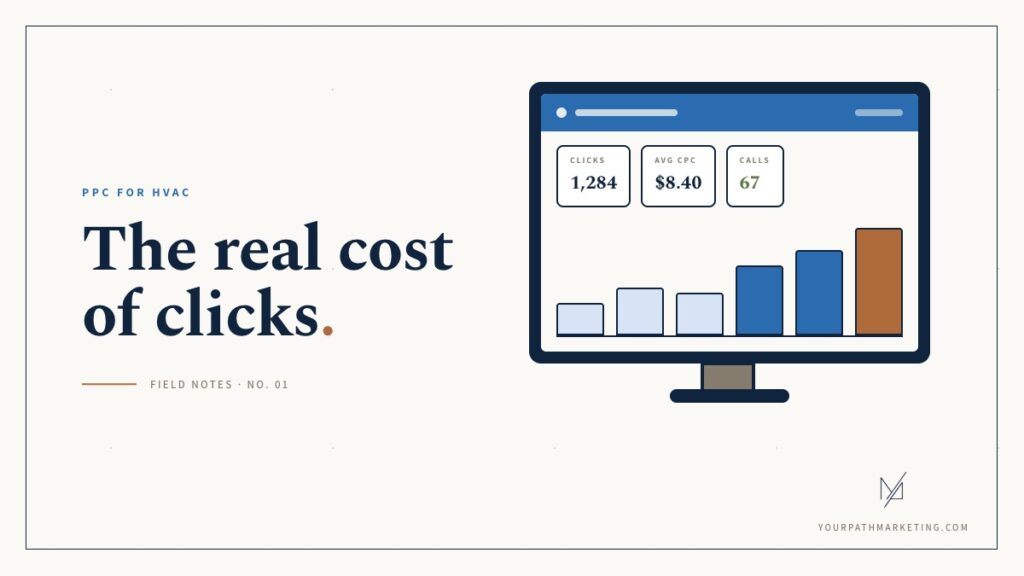
Somewhere in your inbox is a Google Ads invoice from June. It was a hot month. The clicks were not cheap.
PPC for HVAC has a reputation for burning money faster than any other line on an owner’s budget, and there’s a reason for that: you’re paying auction prices for the most urgent moment in home services. This article covers what PPC for HVAC companies actually costs, when paid ads genuinely earn their keep, and how to recognize the month they stop.
One thing before we start: we don’t sell PPC. We build organic and local visibility, which means we have no ad budget to protect and no reason to spin the math. This is the article the ad companies won’t write.
What is PPC for HVAC companies? PPC (pay per click) is advertising where you pay Google each time someone clicks your ad, whether or not they call. The ads appear above the map and the regular results for searches like “emergency AC repair.” You’re bidding against every other company that wants that click.
How much does PPC cost for HVAC? Across home services, the average cost per click is $7.85, and costs rose for 75% of home services businesses last year, according to LocaliQ’s 2025 benchmark report. Emergency and replacement searches run higher, and summer heat waves push them higher still. A workable hvac advertising budget is math, not a flat number; we’ll do that math below.
You’re bidding against everyone’s worst day
Google Ads is an auction. Every time a homeowner searches “AC not cooling,” Google runs a split-second bidding war between every company targeting that phrase, and the auction mechanics reward whoever combines the highest bid with the most relevant ad. Simple enough. The problem is what’s being auctioned.
HVAC clicks are expensive because the moment is expensive. A homeowner with a dead system at 9pm isn’t researching. They’re hiring, tonight, and every advertiser in your market knows it. Urgency is price driver one.
Ticket size is driver two. A replacement job worth five figures justifies aggressive bidding, and those replacement bids drag up the price of repair clicks in the same neighborhood of keywords.
Driver three is who you’re bidding against. Corporate-owned competitors wearing local branding run always-on budgets that treat a $15 click as a rounding error. LocaliQ’s home services data shows subcategory CPCs ranging from under $4 to nearly $14, with urgent trades at the top, and cites Yelp data showing home services led all industries in new business openings, which means more bidders in every auction next year. The meter isn’t just running. It’s speeding up.
There’s a quieter fourth driver worth knowing about: automation. WordStream’s benchmark analysis noted sharper cost-per-click increases on campaigns using smart bidding, where Google’s own systems set the bids. Read that again. The auctioneer is also your bidding agent. Hand google ads for hvac fully over to automation and you’ve asked the person selling the clicks to decide what you pay for them.
The real math: what a PPC budget buys
Forget averages for a minute. Run your own numbers through this. Every assumption is stated so you can swap in yours.
The budget: $3,000 a month.
The clicks: assume an $8 average cost per click, in line with the home services benchmark above. That buys 375 clicks.
The calls: assume 12% of clicks become calls. That’s 45 calls. (If your landing page is your homepage, it will be worse. More on that below.)
The jobs: assume you answer and quote 25 of those calls and book 40% of quotes. That’s 10 booked jobs, or $300 in ad spend per booked job.
Whether $300 per job works depends entirely on your average ticket. On a $9,000 replacement, it’s a great trade. On a $250 tune-up, you’re paying Google more than the customer paid you.
Now run peak season. In July, the same auction gets hotter: assume the hvac cost per click jumps to $12. Same $3,000 now buys 250 clicks, roughly 30 calls, and about 7 booked jobs. Your cost per job just climbed 40% and your ad performed exactly the same. That’s the part nobody puts on the invoice: the auction sets your price, and the auction peaks precisely when you’re busiest.
This is rent. The meter runs every month, forever, at whatever the market decides, and the day you stop paying, the visibility is gone.
The number your dashboard hides
Open your Google Ads dashboard and you’ll drown in numbers: impressions, clicks, click-through rate, quality score. Notice what’s missing. Booked jobs.
The dashboard measures everything Google does and nothing your business does. It can’t see that Tuesday’s 14 clicks produced two voicemails and a wrong number, or that one Thursday click became an $11,000 replacement. Without call tracking, the connection between spend and revenue is a guess wearing a spreadsheet.
The fix is simple and boring: a tracking number on your ad landing pages, so every ad call is attributed to its source, plus a monthly habit of writing three numbers next to each other: what you spent, how many calls it produced, how many became booked jobs. Everything else on the dashboard is weather. Those three numbers are the climate.
One caution while you set this up: use a tracking service that keeps your real number on your public listings. Swapping numbers on your Google Business Profile or across directories can scramble the consistency that local rankings depend on. Track the ads; leave the listings alone.
Do this for one full billing cycle before you make any decision about ads. Owners who run this exercise are sometimes pleasantly surprised. More often they discover their real cost per booked job is double what they assumed, because half the “conversions” in the dashboard were quote-shoppers, spam calls, and people outside the service area.
When PPC genuinely makes sense
Here’s the honest part. Sometimes renting is right, and an article that pretends otherwise is selling you something. Four scenarios where google ads for hvac earn their keep:
You’re new. A company with no visibility history can’t wait months for organic rankings to build. Ads make the phone ring while the foundation gets poured.
You have sudden capacity. A new crew, a slow week, an install schedule with holes in it. Ads are a faucet: expensive water, but it flows the day you turn the handle.
You’re launching a service line. Adding heat pumps or duct cleaning? Your organic presence knows nothing about it yet. Ads bridge the gap while your pages and reviews catch up.
You’re staffed for a surge you can see coming. If you have the techs to handle a heat wave, buying extra calls that week can be rational even at peak prices, because your close rate on emergencies is high.
Notice the pattern: every scenario is a bridge or a burst. None of them is a permanent business model.
When it stops paying
The trouble with rent is that nobody sends you a memo when it stops making sense. Watch for four signals.
Cost per booked job creeping toward the job’s margin. If a $300 acquisition cost becomes $500 on the same mix of work, the auction is eating your profit one quarter at a time. WordStream’s 2026 benchmarks found average CPCs have more than doubled over the past decade, from $2.32 to $5.42. The direction of the meter is not a mystery.
Paying for your own name. Check what percentage of your ad clicks come from people searching your company name. Those homeowners were already calling you. If no competitor is bidding on your brand, you’re buying clicks your map listing would have delivered free.
Rising spend, flat calls. If the budget grows and the phone doesn’t, the extra money is buying position, not customers.
The dependency test. Ask the scariest question in marketing: if I paused ads for 30 days, would the phone stop? If yes, you don’t own any visibility. You’re subletting it.
Run the test honestly and the conclusion writes itself. Google ads for hvac work best as a supplement to visibility you own, not a substitute for it. A company with a strong map presence uses ads to top off a slow week. A company with no organic presence uses ads as life support, at auction prices, indefinitely.
The alternative isn’t “no marketing.” It’s building the kind of visibility that compounds instead of resetting to zero each month: your map presence, your reviews, your service pages. That work is slower to start and it doesn’t stop when you stop feeding it. Here’s exactly what it involves: local SEO for HVAC companies, in plain language, and the owner’s guide that ties it all together.
If you keep running ads, run them like this
Plenty of owners will keep a campaign running, and that’s fine. Five ways to stop the bleeding, whoever manages it:
- Add negative keywords. You should never pay for clicks from “HVAC technician salary” or “HVAC school near me.” Check your search terms report; you might be shocked.
- Match the radius to your trucks. If you don’t roll a truck to a town, don’t buy its clicks. Tight geography is the cheapest optimization there is.
- Send clicks to matching pages. A repair search should land on a repair page with a phone number at the top, not your homepage. Message match is the difference between 12% of clicks calling and 4%.
- Schedule ads around answering capacity. A missed call is the most expensive click you can buy. Run ads when a human answers, or route after-hours clicks to a booking form.
- Split repair from replacement. Different urgency, different ticket, different bid logic. One campaign for both means both are mispriced.
Common mistakes
The mistake: Judging ads by clicks and impressions instead of cost per booked job.
The fix: Track calls with a source number, then divide spend by jobs booked. One number tells you whether the meter is worth it.
The mistake: Sending every click to the homepage.
The fix: Build one landing page per campaign with the service, the town, and a phone number above the fold. It can cut your cost per call dramatically.
The mistake: Running ads 24/7 when nobody answers after 6pm.
The fix: Schedule ads for staffed hours. Paying for calls that ring out is burning the budget twice: the click and the reputation.
The mistake: Bidding on your own company name out of fear.
The fix: Search your name in an incognito window first. If nobody else is advertising on it, your organic and map listings already own that search for free.
FAQ: PPC for HVAC companies
How much should an HVAC company spend on PPC per month?
Work backward from jobs, not forward from a round number. Decide your target cost per booked job, estimate your click-to-call and close rates, and multiply. For many independent companies that math lands between $1,500 and $5,000 a month, but your ticket sizes decide it, not an industry rule of thumb.
What is a good cost per booked job from Google Ads?
One your margin can carry. As a gut check, many owners aim to keep acquisition under 10% of the job’s value: $50 on a $500 repair, $700 on a $7,000 replacement. If repair campaigns can’t hit that, shift the ad budget toward replacement searches and let organic visibility carry repairs.
Why are HVAC clicks so expensive in summer?
Because demand and competition peak together. Every company in your market bids on the same heat-wave emergencies, and the hvac cost per click rises with the temperature. The searches most worth winning in July are the most expensive ones to buy in July.
Are Google Local Services Ads the same as PPC?
No. Local Services Ads sit above regular ads, charge per call rather than per click, and require background checks to earn the Google badge. They have their own economics and their own problems, and they deserve their own article. Here’s the full breakdown: what Local Services Ads actually cost HVAC companies.
Is PPC or SEO better for HVAC companies?
They answer different questions. PPC buys visibility instantly and stops the day you stop paying. SEO builds visibility slowly and keeps working after the work is done. The real comparison is rent versus own, and for most established companies the answer is a season of both while the owned asset grows. Here’s the math across all three channels, including where the crossover actually falls, and our pricing page shows what the owned side costs.
Can I run HVAC Google Ads myself?
Yes, if you keep it simple: one tight campaign, exact-match keywords, your real service area, negative keywords, and a landing page with a phone number. Where owners get hurt is set-and-forget. The auction changes weekly; an unwatched campaign drifts expensive.
The math is yours now
We just spent 2,500 words on a service we don’t sell, because the math matters more than the invoice. If ads are a bridge for you right now, run them tight and keep the receipts.
And if you’d rather see what your visibility looks like when the meter isn’t running, take the free visibility audit. We work with one HVAC company per service area, so it also tells you whether your towns are still open. Curious what happens after that? Here’s exactly how it works.