
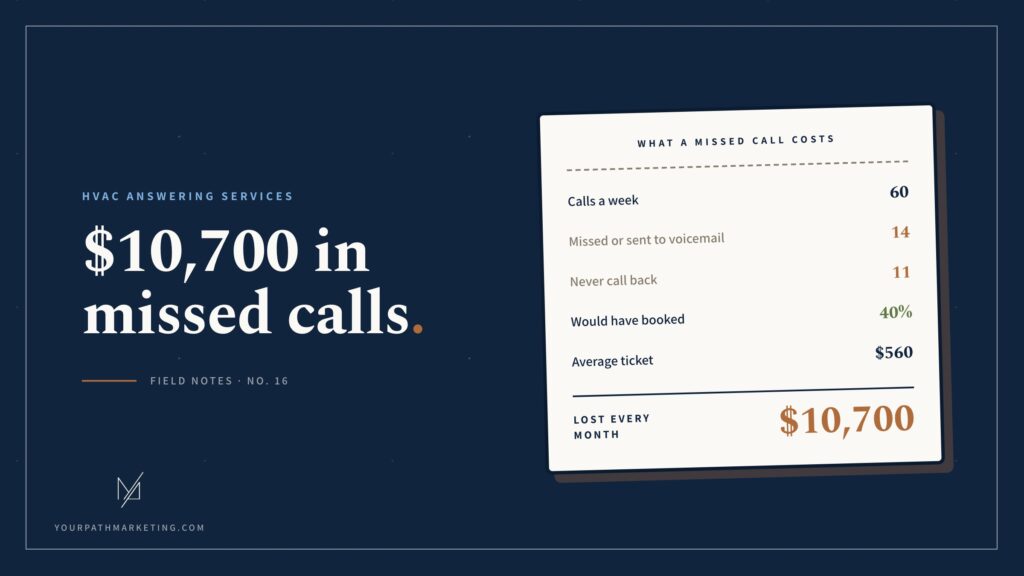
First real heat wave of the summer, Thursday evening. The phone rings eleven times between five and eight. Your office person went home at four thirty. Three of those callers leave a message. The other eight are already talking to somebody else by the time you listen to the first one.
You do not have a phone problem in April. You have one on a Thursday in July, and that is the week the calls are worth the most.
Here is the short version. Almost no shop knows its own miss rate. The industry numbers are unreliable and mostly published by companies selling answering services. And the right fix depends far more on when you are missing calls than on how many, because a Saturday problem and an after-hours problem have different and much cheaper solutions than a staffing problem.
We do not sell answering services and have nothing riding on which option you pick. That is most of why this piece is worth reading.
Nobody agrees on how many calls you are missing
Search this topic and you will meet a wall of confident statistics that do not agree with each other.
The most repeated figure is that 62% of calls to small businesses go unanswered, attributed variously to a ServiceTitan analysis of contractor phone lines and to much older BIA/Kelsey work. Other compilations put home-services misses at 27%. CallRail and Invoca figures get cited at 20% to 30% of inbound volume with seasonal peaks of 40% to 50%. Vendor pages published this year variously claim 30% to 40% for HVAC specifically.
Twenty percent and sixty-two percent are not the same finding. One is a leak you fix at your convenience. The other is an emergency. Nobody should make a staffing decision on a number that wide, and every one of those sources sells answering software or call tracking.
Two figures deserve to be named specifically, because they are everywhere and neither traces to a primary study. The $1,200 average missed call is a constructed number that gets repeated through trade press rather than research, and at least one vendor report says so outright. The 85% who never call back is attributed to Forbes, to BIA/Kelsey, and to several intermediaries in between, depending on who is citing it. Both may be roughly right. Neither is evidence.
What is not in dispute is the direction. A homeowner with no cooling who reaches voicemail usually hangs up and dials the next result. You do not need a statistic to believe that. You have been the next result.
How to measure your own, in ten minutes
Your number is knowable and it is sitting in your phone system right now. This is the most useful thing on this page.
- Export the last 90 days of call detail. Every VoIP system does this, and most cell carriers do too. Look for call logs, call detail records, or call history in the admin portal.
- Count three things. Total inbound calls, answered calls, and calls that lasted under fifteen seconds. That third bucket matters because most of those are hangups, wrong numbers, and robocalls rather than lost customers, and counting them as misses will scare you for no reason.
- Sort by hour and by day of week. This is the step everyone skips and it is the one that decides your answer. The gaps cluster in predictable places: the lunch window, after five, Saturday morning, and the forty-eight hours following the first hot stretch.
- Do the arithmetic with your own numbers. Missed calls times your average booked-job revenue times your close rate on inbound calls. Not an industry average ticket. Yours. And not every missed call was a job, which is what the close rate is doing in that equation.
Now look at the shape of it, not just the size. If your miss rate is 12% and nearly all of it lands on Saturday mornings, you have a Saturday problem. That is a couple of hundred dollars a month to solve. If it is 30% spread evenly across every hour you are open, you have a staffing problem, and that is a different conversation with a different price tag.
When calls actually go missing
Four gaps show up in almost every shop, and each has its own fix.
Lunch. One office person means a ninety-minute hole in the middle of every weekday. It is the easiest gap to cover and the one owners are most surprised by when they see it on the export.
After hours. Reported at roughly a quarter to nearly half of inbound volume for HVAC and plumbing depending on which vendor you ask. Even at the low end, that is a large share of your phone ringing when the office is dark.
Saturday morning. Homeowners notice problems on the weekend because that is when they are home. A Saturday morning call is a homeowner with time to make three calls and pick one.
Surge. The first heat wave, the first freeze. Volume runs several times baseline for two or three days.
That last one is the whole argument in one sentence: surge is when the calls are worth the most and your pickup rate is at its worst. You do not size a system for an average July afternoon. You size it for the design day. The phone works the same way, and almost nobody staffs it that way.
The four ways to cover the phone
Costs below were checked in August 2026. Service pricing comes from vendor pricing pages, and every one of those vendors sells one of these options, so treat those as ranges rather than quotes. Salary figures come from Salary.com, Glassdoor, and ZipRecruiter for the Baltimore market.
| Option | Typical cost | Good at | Bad at | Fits |
|---|---|---|---|---|
| In-house CSR | $37k to $48k base in Baltimore, roughly $50k to $70k loaded | Knows your area, your pricing, your plan holders. Can actually sell an agreement. | One person covers one shift. Lunch, vacation, and nights are uncovered. | Steady daytime volume, low after-hours share |
| Live answering service | $200 to $1,500/mo flat, or roughly $0.75 to $2.50 per minute, or $1.50 to $3 per call | A human voice, 24/7. Captures a name and a callback reliably. | Judgment. Your service area, your pricing, what counts as an emergency. Per-minute bills spike in July. | Shops wanting a person on the line at any hour |
| AI answering | $29 to $2,197/mo depending entirely on the vendor | Answers on the first ring every time. Handles surge without degrading. Flat pricing. | Unusual situations, accents, and a homeowner with no heat in February who needs a person. | Heavy after-hours and surge volume, predictable call types |
| Overflow and after-hours hybrid | Existing staff plus roughly $200 to $650/mo | Your person handles the calls that need judgment. The service catches the rest. | Two systems to keep in sync. Handoff rules have to be written down. | Most 5 to 20 person shops |
A word on that salary line, because it is the number owners underestimate most. Salary.com put a Baltimore customer service representative at about $39,000 in February 2026 and ZipRecruiter had Maryland at roughly $38,000 in July, while Glassdoor runs higher at about $48,000, and a senior one closer to $60,000. Then add payroll taxes, workers compensation, health coverage, and paid time off, which typically brings the real cost to somewhere between 1.25 and 1.4 times base. That is why the loaded figure lands near $50,000 to $70,000, or roughly $4,200 to $5,800 a month. Someone experienced enough to sell an agreement over the phone sits at the top of that range.
Two other things worth saying plainly about that table. The hybrid is the right answer for most shops in this size range, because it puts the expensive human on the calls where judgment pays and the cheap coverage on the calls where a name and a number is enough.
And look at the AI row. That range spans nearly two orders of magnitude for products that all describe themselves the same way. The label tells you nothing. Ask what happens on a call the system cannot handle, and ask to hear a recording of one going wrong rather than one going well.
What good call handling looks like, whoever is doing it
Most owners who have been burned by an answering service were not burned by the category. They were burned by handing over the phone without handing over the information required to use it. Whoever answers needs all of this, in writing, before the first call.
- Your actual service area, by town or ZIP, including the places you will not go. Otherwise you are paying somebody to book a job forty minutes outside your radius.
- Your after-hours policy and what counts as an emergency. No heat below a certain outdoor temperature is an emergency. A noisy blower is not. Write the line down or somebody else will draw it for you at midnight.
- Your diagnostic fee and how it is quoted. A caller who is surprised by the fee at the door is a cancelled job and a bad review.
- The qualifying questions. Equipment type, age, what it is doing, whether there is any heat or cooling at all. Five questions, same five every time.
- Access to book directly into the schedule. This is the one that separates a real solution from a moved problem. A service that only takes messages has not covered your phone, it has relocated your voicemail.
- Your list of agreement holders. If a plan customer calls and is treated like a stranger, the priority promise you sold him is not real. Our article on maintenance agreements covers why that promise is the thing homeowners are actually buying.
Speed matters twice, and they are different problems. Speed to answer decides whether the caller reaches anyone. Speed to call back decides whether the message you did capture turns into a job, and a callback that lands an hour later is competing against a shop that answered live. Fix the first one before you worry about the second.
Before you record anything in Maryland
This section could save you more than every other section combined, and almost nothing written nationally about answering services mentions it.
Maryland is an all-party consent state. Under the Maryland Wiretap Act, Courts and Judicial Proceedings section 10-402, recording a private conversation without the consent of every participant is a felony carrying up to five years in prison and a fine of up to $10,000, plus civil liability to the person recorded. Recordings made in violation are also inadmissible under section 10-405. A 2026 bill that would have reduced the offense to a misdemeanor passed the House and died in the Senate at adjournment in April, so the felony standard stands.
Now connect that to what you are shopping for. Many answering services, AI answering products, and call tracking platforms record by default, and several national vendors treat recording as a standard feature without any state-specific handling. A Maryland shop that switches it on without a consent announcement has a problem no number of extra booked jobs will offset.
Ask any vendor three questions before you sign. Are calls recorded. Does a consent announcement play before recording begins. And can that announcement be enforced per state rather than as a global setting somebody can toggle off. Ask the same three about call tracking, and here we should say plainly that call tracking is adjacent to what we sell, so ask us the same questions you would ask anyone else.
The line moves when you cross it. The District of Columbia is one-party consent under D.C. Code section 23-542, and Virginia is one-party under Virginia Code section 19.2-62. A shop working across the metro takes calls under all three regimes, sometimes on the same afternoon, and the standard practice is to follow the strictest one that could apply. In this region that is Maryland.
Wiretap and consent rules differ by state, and in Maryland the penalties are criminal rather than civil, so confirm your setup with an attorney before you record anything. This is not legal advice and we are not attorneys.
Running the numbers for your shop
Every figure below is invented. Substitute your own from the export.
A shop taking 180 inbound calls a month. The export shows 40 unanswered, but 12 of those ran under fifteen seconds, so call it 28 real misses, a miss rate of about 16%. Average booked job $480. Close rate on inbound calls 45%. That is 28 times 0.45 times $480, or roughly $6,000 a month of work that went somewhere. Assume half of those people called back or were caught later, which is generous, and you are still looking at around $3,000 a month.
Now the shape. Twenty-two of those 28 misses landed after five o’clock or on Saturday morning. So the fix is an after-hours and weekend service at roughly $200 to $650 a month, catching most of a $3,000 problem. Adding a second in-house person at $4,200 to $5,800 a month loaded to cover the same gap does not pencil, and would leave the nights uncovered anyway.
Now change one input. Make it a replacement-heavy shop with an $8,000 average ticket. At the same volumes, a single recovered job pays for a year of any option on the table, and the analysis stops being about cost and starts being about which option books best. Ticket size flips the answer more than call volume does.
Run it before you shop. A vendor cannot tell you which quadrant you are in, and every one of them will assume you are in theirs.
Fix the phone before you raise the budget
This is the part where our interest is visible, so weigh it accordingly.
Voicemail is a return duct that goes nowhere. Everything upstream can be sized correctly and it still will not move any air.
Money spent on being found only converts if somebody answers. If your measured miss rate is 30%, then the real cost of every marketing dollar is roughly a third higher than the invoice says, whether that dollar went to search work, to a marketplace where you pay per contact, or anywhere else. Paying for a call and then missing it is the most expensive thing in this article.
So the order matters. Measure the phone. Fix the gaps you find. Then increase the budget, and see our piece on where an HVAC dollar works hardest when you do.
Frequently asked questions
How much does an HVAC answering service cost?
Checked August 2026: live services run roughly $200 to $1,500 a month flat, or $0.75 to $2.50 per minute, or $1.50 to $3 per call. AI products range from about $29 to $2,197 a month. All figures come from vendor pricing pages, so confirm current terms directly.
Is it cheaper to hire someone or use a service?
A Baltimore customer service representative runs about $37,000 to $48,000 in base pay per 2026 salary data, or roughly $50,000 to $70,000 once payroll taxes, insurance, and time off are counted. A service covering nights and weekends costs a fraction of that, but it will not sell an agreement.
Should I use AI or a live answering service?
It depends on when your calls go missing and what they are worth. AI handles surge and after-hours volume cheaply and predictably. A live service handles unusual or emotional calls better. Most shops in the 5 to 20 person range do best with in-house staff plus one of these catching overflow.
What percentage of calls do HVAC companies miss?
Published figures range from about 20% to 62%, and nearly every source sells answering software. That range is too wide to plan around. Export 90 days of call detail from your phone system and measure your own, which takes about ten minutes.
Can an answering service book jobs directly?
Some can, and it is the feature that matters most. A service that only takes messages has moved your voicemail rather than covered your phone. Ask specifically whether it writes into your scheduling software and what happens when the schedule is full.
Is it legal to record calls in Maryland?
Only with the consent of every participant. Maryland is an all-party consent state and a violation of the Wiretap Act is a felony carrying up to five years and a $10,000 fine. Many services record by default, so confirm the setting and the consent announcement with an attorney before switching it on.
Do I need 24/7 coverage?
Only if your call log says so. Look at what share of your missed calls land outside business hours. If most of your gaps are at lunch and on Saturday mornings, a much smaller and cheaper fix covers the actual problem.
Pull the call log this week
Everything on this page comes down to one action, and it costs nothing. Export ninety days, count the misses, sort them by hour and by day, and multiply by your own numbers. You will know in ten minutes whether you have a real problem, and more usefully, which two hours of the week it lives in.
Then buy the smallest thing that covers those hours. Most shops need far less than the vendors are selling, and a few need considerably more, and the only way to know which one you are is to look.
And if you want the other half of the picture, that is what the free visibility audit is for: your rankings in every town you serve, your profile against the competitor winning your market, and whether AI tools name you or them when a homeowner asks who to call. One page, two business days, yours either way. We work with one HVAC company per service area, so it also tells you whether your towns are still open. Here is how the rest works. Worth a look?