
Open your field software and count the contacts. Most shops your size find somewhere between eight hundred and five thousand people in there. Every one of them let you into their house.
You have a second maintenance base sitting in that software, and nobody has ever serviced it.
Here is the short version of this whole article. Your past customer list is the cheapest source of booked jobs you own, three campaigns capture most of the value, and the setup takes an afternoon. HVAC email marketing is not a new channel you are adding. It is the only channel where you already paid the acquisition cost.
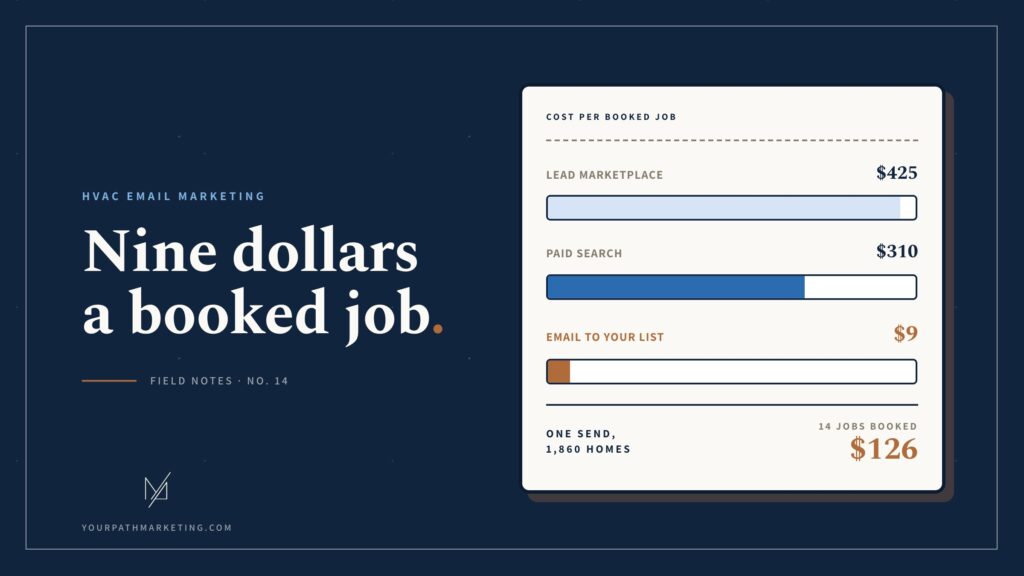
That last point is worth a number. WebFX’s 2026 HVAC benchmarks put the industry average at $153 to generate one new customer inquiry, with average cost per click at $29.03 in 2024 and projected at $32.77. Reaching a homeowner already in your database costs a fraction of a cent. He already knows your name, he already has your equipment in his basement, and he is not comparing you to three strangers in a map pack.
The list you already own
Pull four groups out of the software. Past customers. Unsold estimates. Agreement holders. And anyone who ever called, even once, even if it went nowhere.
A contact is usable if it has four things: an email address, a service address, some record of the equipment, and a date of last service. That fourth field is what makes everything below work. Without it you are sending the same message to everybody, which is the thing that does not work.
Most owners are surprised by the count. The list has been growing for fifteen years while nobody looked at it.
About that $40-to-$1 number
Every article on this subject opens with email returning $36 to $42 for every dollar spent. You will see it quoted as though it were measured.
It is not. That figure traces back to self-reported marketing surveys, and the companies repeating it for HVAC are companies that sell email software. It is directionally believable. It is not evidence, and it is certainly not evidence about your shop.
The only number that settles it is yours, and it is a two-column spreadsheet. Revenue from jobs you can trace to a send, divided by what the send cost you. If your tool costs $30 a month and one fall tune-up email books six visits at a $180 average ticket, you do not need an industry benchmark to tell you whether that worked.
Same disclosure applies here. Most of the HVAC email statistics circulating this year come from vendors selling email services. We sell search visibility, which is its own kind of interest, and it shows up in one section near the end.
Campaign one: the fall tune-up
Goes to every past customer with a heating system. Sends in August, before anyone in Maryland is thinking about heat and before every other shop’s postcard lands. The whole point is arriving early. Our article on surviving the slow season makes the same argument about outbound calling: the work that fills September happens in August.
Short, dated, one way to respond. That is the entire design.
Subject: Getting the heat checked before October
Hi [First name],
Your [furnace / heat pump] at [service address] is due for its heating check. We are booking those through the end of October, before the first cold week fills the schedule.
It takes about an hour. If something needs attention, you hear it from us now instead of at nine o’clock on a Sunday in January.
Reply with two days that work, or call [phone].
[Owner first name]
[Company]
Campaign two: the estimate that went quiet
Goes to anyone who got a quote and never booked, thirty to ninety days later. This is the most valuable list in your building and almost nobody works it. These people already invited you out, already know your pricing, and already decided you were worth talking to.
The email does not re-pitch. It asks whether anything changed, and it points out that the equipment is a season older than it was when you looked at it.
Subject: Following up on the estimate from [month]
Hi [First name],
I sent you an estimate back in [month] for [the work] and never heard anything, which usually means the timing was not right. That happens.
Two things. Has anything changed on your end? And your [system] is a season older now than when I looked at it, so if you want me to check it again before winter, I will do that at no charge.
If you went another direction, tell me and I will take you off the list. No hard feelings.
[Owner first name]
[Phone]
Campaign three: the review request
Goes within a day or two of a completed job, while the visit is still the most recent thing that happened.
Detailed reviews are worth more to you than bare star ratings, because search engines and AI assistants read the text rather than counting stars. But you cannot ask for the detail. Google’s policy prohibits merchants from requesting that specific content be included in a review, so the ask stays open. Invite the customer to say how it went and let them decide what that means.
Rotate the platform, too. Bing pulls its review content from Yelp and Facebook rather than Google, so a shop with four hundred Google reviews and nothing anywhere else looks thin to half the systems now answering homeowner questions.
Two hard lines. Never offer anything in exchange, and never send this only to the customers you expect to be happy. Both break platform rules, and incentives carry federal penalties as well. Our article on getting more Google reviews covers the current rules in full and has the scripts for text, email, and the doorstep.
Subject: Thanks from [Company]
Hi [First name],
We were out [yesterday / Tuesday] for [the work]. I wanted to make sure everything is running the way it should be. If it is not, reply to this and I will get someone back out.
Either way, would you leave us a review? It helps other people in [Town] find us.
[link]
Thanks for the work.
[Owner first name], [Company]
Note what that email does not do. It does not make the ask conditional on the job having gone well, because asking only the happy ones is prohibited. It does not tell the customer what to write. And it gives an unhappy customer a way to reach you first, which is allowed, as long as everybody still gets the same review link.
There is a fourth campaign worth naming and not templating: the note to anyone running a system over twelve years old. It works, but it works better as a phone call than an email, and it is already covered in the slow-season article. Put it on the calling list, not the send list.
Why your email is not arriving
Deliverability is the static pressure of email. Invisible, decisive, and nobody checks it until the system is underperforming for reasons nobody can name.
Since February 2024, Google and Yahoo have enforced a shared set of sender rules, and Microsoft joined in May 2025. Current 2026 reporting from PowerDMARC puts compliant senders at roughly 89% inbox placement, against 22% to 34% of mail routed to spam for senders who are not compliant.
One honest note before the checklist. The strict rules kick in at 5,000 messages a day to a single provider, and a shop with three thousand contacts sending once a month is nowhere near that. You are not technically a bulk sender. Do all of it anyway, because the filters read the same signals regardless of your volume, and because the setup is a one-time job.
- Send from your own domain. Not a Gmail address, not the email platform’s shared sending domain. Mail from yourname@yourcompany.com is the whole basis of a sending reputation you can build.
- Set up SPF, DKIM, and DMARC. Three DNS records that prove the mail really came from you. Whoever manages your domain can do all three in about thirty minutes, once, and then it is done.
- Never buy or import a list you did not collect. Purchased lists generate spam complaints, and complaints are the fastest way to poison delivery for the customers who actually want to hear from you.
- Clean the list. Dead addresses bounce, and bounces cost you inbox placement for everyone else on the send. Google now rejects mail outright from senders whose bounce rate runs too high.
- Make unsubscribing easy and honor it immediately. Google and Yahoo require one-click unsubscribe and expect opt-outs processed within two days. Spam complaints must stay under 0.3%, which on a list of three thousand is nine people hitting the button.
Email to customers is regulated under CAN-SPAM, and Maryland has its own rules on commercial messages. This is not legal advice and we are not attorneys, so have someone who knows the law look at your setup before you send at volume. The practical version is short: an accurate sender name, a real physical address in the footer, a working unsubscribe link, and a subject line that describes what is actually inside.
The three numbers to watch, and the one to ignore
Ignore open rate. It is broken, and this is the single most useful thing in this article.
Apple’s Mail Privacy Protection pre-loads images on every message that arrives in Apple Mail, which registers as an open whether or not a human ever looked at it. Multiple 2026 benchmark compilations, including MailTester’s June 2026 analysis, put the inflation at 15 to 20 percentage points and estimate real human open rates closer to 20% to 30%. Apple Mail now accounts for around 60% of all recorded opens.
So when a vendor congratulates you on a 34% open rate, roughly half of that is a machine. It is not comparable to anything from before 2021 and it should never be your success metric.
Watch three things instead, monthly. Clicks, because a click takes a deliberate hand. Replies, which on a list this size are the real signal, since a homeowner writing back is a homeowner booking. And booked jobs traced to a send, which is the only one that pays for anything.
Tracing does not need to be sophisticated. A distinct phone number in the email works. So does a line asking people to mention the email when they call, as long as whoever answers the phone writes it down. If you are on a field software platform, it does this for you. Then it is arithmetic: revenue from those jobs divided by the monthly cost of the tool. Our article on where an HVAC dollar works hardest runs the same comparison across every channel.
How often, and what not to send
One useful email a month is plenty, and it beats a weekly newsletter nobody asked for. A homeowner needs to hear from you before each season and after each job. That is roughly it.
Sending everyone the same thing is running one speed on a two-stage system. It works, technically, and it wastes most of what you paid for. Your software knows who has a heat pump and who has a boiler. Use it.
- Do not send a newsletter about your company. Nobody outside your family wants an update on the new truck. Send something the homeowner can act on or do not send anything.
- Do not skip segmentation. A furnace reminder to a customer with a heat pump tells him you do not remember what you installed, which is worse than not writing at all.
- Do not turn it into a discount channel. A list that only ever gets offers learns to wait for offers. That is the same trap as discounting your way through a slow September, and it costs you the same way.
The shops that get this right send less than they think they should and it works better.
What this has to do with being found
This is the part where our own interest shows, so read it accordingly.
A homeowner who gets a useful note from you twice a year searches your company name when something breaks. He does not search “hvac near me” and take his chances with whoever is closest. That is branded search, and it is the only demand you own rather than rent.
The review campaign feeds the other side of it. Detailed reviews are what search engines and AI assistants read when a stranger asks who to call, and the customers most likely to write one are the ones who hear from you between visits. Our local search page covers how that compounds.
Frequently asked questions
Does email marketing work for HVAC companies?
Yes, for reaching people who already hired you. It is the cheapest channel you have because the acquisition cost is already spent. It does not find new customers, so treat it as a retention and rebooking tool rather than a replacement for being found in search.
What should an HVAC company email its customers about?
Seasonal tune-up reminders before each season, follow-ups on estimates that never closed, and review requests after completed work. Those three cover most of the value. Skip company newsletters. If the homeowner cannot act on it, it is not worth sending.
How often should I email my customer list?
About once a month, plus automatic messages triggered by a completed job or an aging estimate. More than that and unsubscribes climb without booked jobs following. Frequency matters far less than whether the message is relevant to the equipment that customer actually owns.
What is a good open rate for HVAC email?
Do not use open rate. Apple Mail Privacy Protection inflates it by 15 to 20 percentage points by registering opens that never happened, so 2026 numbers are not comparable to older ones. Track clicks, replies, and booked jobs traced to a send instead.
Can I email customers who have not opted in?
Existing customers are generally reachable about work you did for them, but the rules are specific and Maryland adds its own. Never email a purchased list. Confirm your setup with someone who knows the law before sending at volume.
What is the best email tool for a small HVAC company?
Usually the one already inside your field software, because it knows the equipment and the service dates. A standalone tool works too. What matters is that it sends from your own domain, supports one-click unsubscribe, and lets you segment by equipment type.
Send the first one this week
Pull the list, pick the fall tune-up, and send it to the customers with heating equipment. That is a two-hour afternoon and it is the whole program getting started. The other two campaigns can wait until the first one has run once.
Nothing here requires a budget, a vendor, or a strategy document. It requires somebody to open the software and look at what is already in it. Most shops never do, which is exactly why it still works.
And if you would rather know where you stand with the homeowners who have not hired you yet, that is what the free visibility audit is for: your rankings in every town you serve, your profile against the competitor winning your market, whether your reviews say anything a stranger can use, and whether AI tools name you or them when someone asks who to call. One page, two business days, yours either way. We work with one HVAC company per service area, so it also tells you whether your towns are still open. Here is how the rest works. Worth a look?